Key takeaways
- The most common symptoms of a bad fuel pressure regulator are black smoke, a fuel smell, fuel in the vacuum hose, hard starts after sitting, misfires and poor fuel economy.
- A fuel pressure test is the only reliable way to confirm it. Expect $100–$200 for diagnosis at a shop.
- On older return-style systems, a rail-mounted regulator usually costs $200–$500 to replace.
- Many newer cars use returnless systems with the regulator inside the tank, often replaced with the fuel pump module for $500–$1,200+.
- Estimates as of 2026; a leaking regulator is a fire risk, so don’t put it off.
The classic symptoms of a bad fuel pressure regulator are black smoke from the exhaust, a strong fuel smell, raw fuel in the regulator’s vacuum hose, hard starting after the car sits, rough idle or misfires, and a drop in gas mileage. A regulator that sticks the other way can cause low fuel pressure, hesitation and stalling. The only way to confirm it is a fuel pressure test. On many older cars, replacing a regulator on the fuel rail costs about $200 to $500 at an independent shop in 2026, while newer returnless systems often need a fuel pump module for $500 to $1,200 or more. This guide explains the signs, how the two system types differ, and what the fix costs.
📩 Important: after you sign up, open the email from Super Car Digest and tap Confirm. Your checklist opens right away. Not there? Check Spam or Promotions.
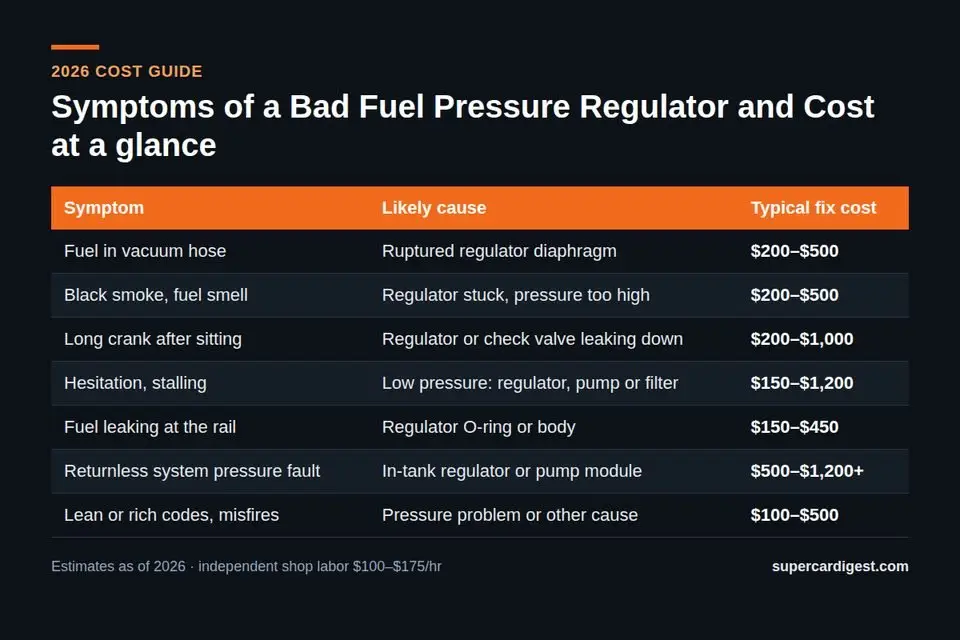
Fuel pressure regulator symptoms at a glance
| Symptom | Likely cause | Typical fix cost |
|---|---|---|
| Fuel in vacuum hose | Ruptured regulator diaphragm | $200–$500 |
| Black smoke, fuel smell | Regulator stuck, pressure too high | $200–$500 |
| Long crank after sitting | Regulator or check valve leaking down | $200–$1,000 |
| Hesitation, stalling | Low pressure: regulator, pump or filter | $150–$1,200 |
| Fuel leaking at the rail | Regulator O-ring or body | $150–$450 |
| Returnless system pressure fault | In-tank regulator or pump module | $500–$1,200+ |
| Lean or rich codes, misfires | Pressure problem or other cause | $100–$500 |
What a fuel pressure regulator does
Fuel injectors need steady, precise fuel pressure to spray the right amount of fuel. The fuel pressure regulator keeps that pressure in a set range. On traditional systems, it uses a spring-loaded diaphragm connected to engine vacuum. When pressure gets too high, it opens a passage that sends extra fuel back to the tank through a return line.
Return-style systems
Common on many cars and trucks built through the early 2000s and on some later models, these have the regulator mounted on or near the fuel rail with a small vacuum hose attached. They are usually easy to reach and replace.
Returnless systems
Most modern vehicles use returnless fuel systems. The regulator is built into the fuel pump module inside the tank, or the engine computer controls pressure by changing pump speed and reading a fuel rail pressure sensor. There may be no separate regulator to replace, and the fix is often the pump module or the sensor. Direct-injection engines also have a high-pressure pump on the engine with its own controls.
Find out which system you have
Look for a small canister with a vacuum hose on or near the fuel rail. If you find one, you likely have a return-style regulator. If not, your car probably uses a returnless system, and diagnosis will focus on the pump module and rail pressure sensor.
Signs of a bad fuel pressure regulator
1. Fuel in the vacuum hose
On a return-style regulator, pull the vacuum hose off with the engine off. If fuel drips out or the hose smells strongly of gasoline, the diaphragm is ruptured. Raw fuel is being drawn into the intake, which causes rich running and smoke.
2. Black smoke from the exhaust
Too much fuel burns incompletely and leaves black, sooty smoke. You may also see black soot on the tailpipe or smell fuel at idle.
3. Hard starting
A leaking regulator can let pressure bleed off overnight, so the engine cranks longer before it starts. It can also flood the engine with fuel, which causes the same long crank on a warm engine.
4. Misfires, rough idle and fouled plugs
Incorrect pressure throws off the air-fuel mix. Rich running can foul spark plugs and trigger misfire codes, while lean running can cause stumbling.
5. Poor fuel economy
If your mileage drops noticeably with no change in driving, high fuel pressure is one possible cause.
6. Hesitation and loss of power
A regulator stuck open drops pressure, starving the engine under load. A weak fuel pump or clogged filter causes the same symptom, which is why testing matters.
How to diagnose it
A mechanic will connect a fuel pressure gauge to the test port on the fuel rail and compare readings with the manufacturer’s specification at key-on, idle and with the vacuum hose removed. On a return-style system, pressure should rise when vacuum is removed. They will also check how well pressure holds after the engine is shut off.
On returnless systems, a scan tool reads the rail pressure sensor and the pump commands. Fuel trim data helps too: high positive trims point to a lean condition, high negative trims to a rich one. An upstream O2 sensor or a bad mass air flow sensor can mimic regulator problems, which is why guessing gets expensive.
Fuel leaks are a fire hazard
If you smell raw fuel in the engine bay or see fuel dripping, don’t drive the car. The fuel system is under pressure even with the engine off on many vehicles. Leave pressure testing and line work to a shop unless you have the right tools and experience.
Regulator, fuel pump or something else?
Several fuel and air problems look alike from the driver’s seat. A few patterns help narrow it down before you pay for parts:
- High pressure, rich running, fuel in the vacuum hose: points strongly to a return-style regulator.
- Low pressure that improves when the return line is briefly pinched by a technician: the regulator is likely leaking back to the tank.
- Low pressure that does not improve: a weak fuel pump, clogged filter or restricted line is more likely.
- Normal pressure but rough running: look at ignition parts such as ignition coils, injectors, or air metering.
Paying for a proper diagnosis is usually cheaper than replacing a regulator, then a pump, then a sensor until the problem goes away.
Fuel pressure regulator replacement cost
On a return-style system with the regulator on the fuel rail, the part usually costs $30–$150 aftermarket or $80–$250 OEM, and labor is about 0.5 to 1.5 hours. Most independent-shop bills land between $200 and $500. Regulators buried under the intake manifold on some V6 and V8 engines can cost more.
On a returnless system, the regulator is usually part of the fuel pump module inside the tank. The module often costs $200–$700, and labor to drop the tank or open an access panel adds 1.5 to 3 hours, putting totals around $500–$1,200 or more. If the problem is the rail pressure sensor instead, expect roughly $150–$400.
If the regulator has been flooding the engine for a while, ask the shop to check the spark plugs and catalytic converter, since rich running can damage both. If the bill is climbing on an older car, our guide on whether it’s worth fixing an old car can help.
Useful on Amazon for this job
As an Amazon Associate we earn from qualifying purchases. Always confirm fit for your exact vehicle or ask your dentist.
Super Car Digest · $14
The Used Car Buying Playbook
Big repair bill on an older car? Before you pay for it, run the numbers on replacing the car — and if you do switch, don’t overpay for the next one. Budget worksheet, 15-minute VIN screen, test-drive routine, word-for-word negotiation scripts and a 10-point contract check.
Frequently asked questions
What are the symptoms of a bad fuel pressure regulator?
Black smoke, fuel smell, fuel in the vacuum hose, hard starts, misfires, poor mileage, and sometimes hesitation or stalling.
How much does it cost to replace a fuel pressure regulator?
About $200–$500 for a rail-mounted regulator. In-tank regulators on returnless systems often mean a pump module at $500–$1,200 or more. Estimates as of 2026.
Can a bad fuel pressure regulator cause no start?
Yes. It can flood the engine or let pressure drop too low to start, though a failed fuel pump is a more common cause of a no-start.
Can I drive with a bad fuel pressure regulator?
It is not recommended. Running rich can damage the catalytic converter, and a leak is a fire risk.
Does my car have a fuel pressure regulator?
All gas engines regulate fuel pressure, but many modern cars have it inside the tank or controlled electronically, with no separate part on the engine.
What codes does a bad regulator set?
There is no single code. Lean or rich codes such as P0171, P0172, misfire codes, and fuel rail pressure codes such as P0087 or P0191 are common.
Sources and methodology
Price ranges combine 2026 estimates from the RepairPal estimator for fuel pressure regulator and fuel pump replacement, standard OBD-II code definitions, published labor-time guides, current retail parts pricing, and labor at typical 2026 shop rates ($100–$175/hr independent, $150–$250/hr dealer; AAA has reported national averages around $140/hr). These are estimates; your quote will vary by vehicle, region and condition.