Key takeaways
- Most 4-cylinder engines cost $100–$300 for a spark plug replacement at an independent shop. Plugs are $20–$100 a set; labor is often under an hour.
- V6 and V8 engines usually run $200–$600. On many transverse V6s the intake plenum must come off to reach the rear plugs, pushing the bill to $400–$800+.
- Modern iridium and platinum plugs commonly last 60,000–120,000 miles; copper plugs need changing every 20,000–30,000 miles.
- Dealers often charge $250–$900 for the same job because of higher labor rates.
- Estimates as of 2026; your price depends on the engine, plug type and local labor rates ($100–$175/hr independent, $150–$250/hr dealer).
The spark plug replacement cost in 2026 is about $100 to $300 for most 4-cylinder cars and $200 to $600 for V6 and V8 engines at an independent shop. Parts are the small part of the bill: a set of iridium plugs usually costs $40–$120, while labor runs $60–$500 depending on how hard the plugs are to reach. Some V6 engines hide three plugs under the intake manifold, and that alone can double the price. Here is what you should expect to pay, which plug type makes sense, and how to tell whether your quote is fair.
📩 Important: after you sign up, open the email from Super Car Digest and tap Confirm. Your checklist opens right away. Not there? Check Spam or Promotions.
Spark plug replacement cost in 2026 at a glance
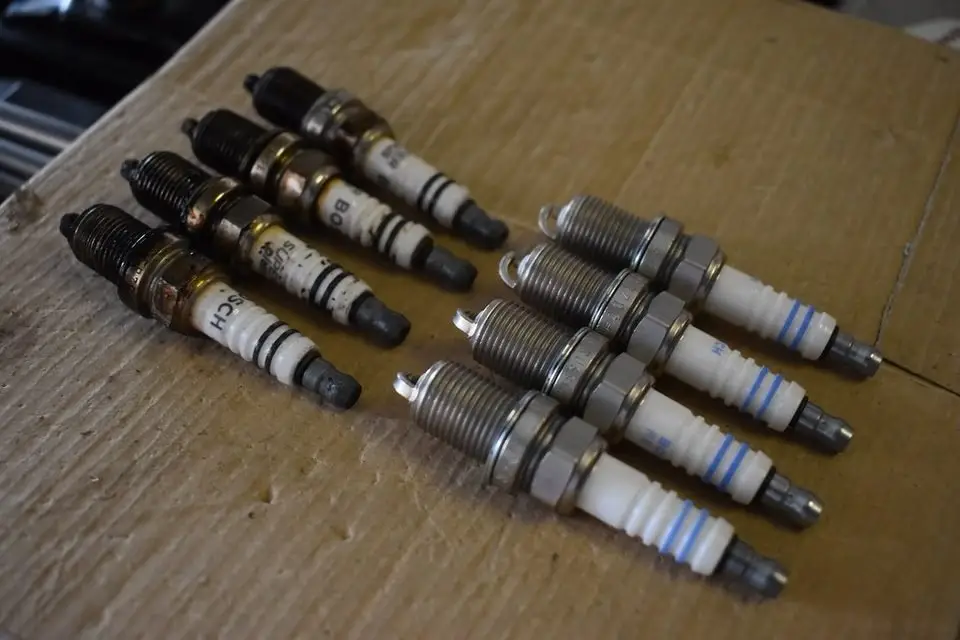
| Engine / job | Plugs (set) | Labor | Typical total (independent shop) |
|---|---|---|---|
| 4-cylinder, easy access | $20–$100 | 0.5–1 hr ($50–$175) | $100–$250 |
| 4-cylinder, turbo or tight access | $40–$120 | 1–1.5 hrs | $150–$350 |
| V6, all plugs accessible | $30–$150 | 1–1.5 hrs | $200–$400 |
| V6, intake plenum removal required | $30–$150 + gaskets $20–$60 | 2.5–4 hrs | $400–$800+ |
| V8, conventional | $40–$160 | 1.5–3 hrs | $250–$600 |
| Spark plugs + ignition coils (4-cyl) | $150–$400 | 0.5–1.5 hrs | $250–$600 |
| Spark plugs + coils (V6/V8) | $250–$700 | 1–4 hrs | $400–$1,200 |
| Dealership, OEM plugs | OEM | $150–$250/hr | $250–$900 |
What spark plugs do and how coil-on-plug works
A spark plug fires a small electric arc inside each cylinder to ignite the fuel and air. A 4-cylinder engine has four plugs, a V6 has six, and a V8 has eight. A few engines, including some Chrysler HEMI V8s and older Mercedes engines, use two plugs per cylinder, which doubles the parts cost.
Almost every modern car uses coil-on-plug ignition. Each plug has its own ignition coil sitting directly on top of it, held by a bolt and a connector. To change the plugs, the technician unplugs and removes each coil first. That is easy on a 4-cylinder where the coils sit in a row on top of the engine, and harder on engines where the rear coils are buried under other parts.
Copper vs. platinum vs. iridium
| Plug type | Price per plug | Typical life | Best for |
|---|---|---|---|
| Copper | $2–$8 | 20,000–30,000 miles | Older cars and engines that specify copper |
| Platinum / double platinum | $5–$15 | 60,000–100,000 miles | Many 2000s–2010s engines |
| Iridium | $8–$25 | 60,000–120,000 miles | Most modern engines, turbo engines |
Use the plug your engine was designed for. Putting copper plugs in an engine that calls for iridium saves a few dollars now but means paying for labor again far sooner. On engines where the intake has to come off, that is an expensive mistake.
Signs your spark plugs need replacing
- Rough idle or a shaky feeling at stop lights.
- Misfires and a flashing or steady check engine light, often with codes P0300–P0308.
- Hesitation or stumbling when you accelerate.
- Hard starting, especially in cold weather.
- Lower fuel economy than usual.
- High mileage with the original plugs still in. Check your maintenance schedule even if the car runs fine.
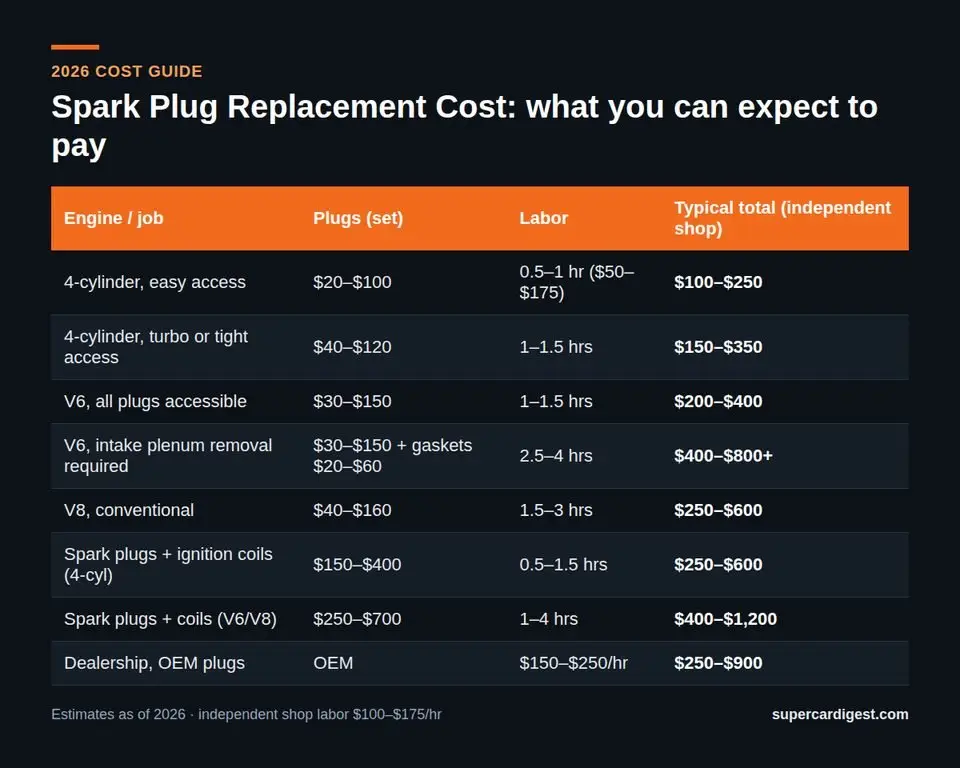
When a technician pulls the plugs, they can also tell a story. Oil on the plug threads or in the plug wells usually means leaking valve cover gasket or spark plug tube seals. White, crusty deposits can point to coolant getting into the cylinder, which is worth checking with a coolant leak test.
Is it safe to drive with bad spark plugs?
Worn plugs that only cause a slightly rough idle are not an emergency, but plan to replace them within a few weeks. The car will burn more fuel and the ignition coils have to work harder, which can shorten their life.
A flashing check engine light is different
A flashing check engine light means a severe misfire. Unburned fuel is going into the exhaust and can overheat and destroy the catalytic converter, which often costs $1,000–$2,500 or more to replace. Slow down, avoid hard acceleration, and get the car checked as soon as possible.
What drives the price up or down
1. Engine layout
On a 4-cylinder, the plugs are lined up on top of the engine. On a transverse (sideways-mounted) V6, common in front-wheel-drive sedans and minivans, the rear three plugs sit against the firewall. On many of these engines the upper intake manifold or plenum must be removed, which adds 1.5–3 hours of labor plus new intake gaskets. Ask your shop whether your engine is one of them before you approve the quote.
2. Plug type and count
Eight iridium plugs cost more than four copper plugs, but the difference is usually under $150. Labor is the bigger variable.
3. Seized or broken plugs
Plugs left in for 150,000 miles or more can seize in aluminum heads. Some engines, such as certain older Ford 3-valve V8s, are known for plugs that break during removal. Extracting a broken plug can add $100–$500 or more.
4. Coils and boots
Shops often recommend new ignition coils at the same time. That makes sense if a coil is causing misfires or the car has very high mileage, but healthy coils can usually be reused. Cracked coil boots are cheap and worth replacing.
Model-specific gotchas that change the quote
Two cars with the same number of cylinders can have very different spark plug bills. These are the layouts that most often surprise owners:
- Sideways-mounted (transverse) V6 engines in many crossovers, minivans and sedans: the front three plugs are easy, but the rear three sit under the upper intake manifold against the firewall. The intake usually has to come off, which adds labor and a set of intake gaskets. On some minivans and SUVs the windshield cowl and wiper assembly also come out for clearance.
- Chrysler/Jeep/Ram 3.6L Pentastar V6: the plastic upper intake sits over the plugs on this engine even in trucks and Jeeps, so the intake comes off and new intake seals are needed every time.
- Ram, Dodge and Jeep 5.7L and 6.4L HEMI V8s: these engines use two spark plugs per cylinder (16 total), so the parts bill roughly doubles compared with a typical V8.
- GM 5.3L and 6.2L V8 trucks: mostly straightforward, but the rearmost plugs near the firewall need a swivel socket and patience.
- Ford 5.4L 3-valve V8 (mid-2000s F-150 and Expedition): the original two-piece plugs are known for breaking off in the head during removal. Many shops quote extra time for a possible broken-plug extraction.
- Subaru boxer engines: the plugs point sideways toward the frame rails with very little room, so even a four-cylinder can take a couple of hours.
If your quote seems high, ask the shop which of these applies to your engine. A legitimate quote will usually line up with one of them.
Dealer vs. independent shop vs. DIY
| Option | 4-cylinder | V6 / V8 | Notes |
|---|---|---|---|
| Dealership | $250–$450 | $350–$900 | OEM plugs, highest labor rate |
| Independent shop | $100–$300 | $200–$800 | Same plugs, lower hourly rate |
| DIY | $20–$100 | $30–$160 | Needs a spark plug socket, extensions and a torque wrench |
On most 4-cylinders, changing plugs is one of the easiest DIY jobs. Work on a cold engine, change one plug at a time, check the gap if the plugs are not pre-gapped, and torque them to spec. Over-tightening can strip the threads in an aluminum head, which turns a $60 job into a major repair. Leave intake-removal V6 jobs to a shop unless you are comfortable with vacuum lines and intake gaskets.
DIY mistakes that turn a cheap job into an expensive one
- Work on a cold engine. Aluminum heads expand more than steel plugs when hot, and pulling plugs from a hot head can damage the threads.
- Blow out the plug wells first. Use compressed air before loosening each plug so dirt does not fall into the cylinder.
- Start every plug by hand. Thread it in with just the socket and extension (or a short piece of rubber hose over the plug) for several full turns before using a ratchet. If it binds, back it out and realign.
- Use the right socket. Many newer engines use a 14mm thin-wall plug socket rather than the classic 5/8 in. A magnetic or swivel plug socket also helps in deep wells.
- Skip the anti-seize on plated plugs. Most major plug makers coat their threads already and advise against anti-seize, because it lowers friction and makes over-tightening easy. Follow the plug maker’s torque spec with a torque wrench.
- Don’t pry iridium tips. The fine center electrode breaks easily. Check the gap gently with a wire gauge and adjust only the ground strap if needed; most iridium plugs come pre-gapped.
- A dab of dielectric grease inside the coil boot (not on the terminal) helps seal out moisture and keeps the boot from sticking to the plug next time.
Beware of counterfeit plugs
Fake versions of major brands are sold through some third-party marketplace sellers at prices that look too good. Buy from an authorized parts store, a reputable online parts retailer or a dealer parts counter.
How to pay less without cutting corners
- Follow the interval in your manual, not a shop’s generic schedule.
- Ask if intake removal is needed and get the labor hours in writing.
- Bundle work. If the intake is coming off anyway, replace leaking valve cover or intake gaskets at the same time.
- Buy the plugs yourself if your shop allows it, but use the OEM brand and part number.
- Don’t replace coils blindly. Replace only the ones that test bad, unless mileage is very high.
When to walk away from the repair
Spark plugs are routine maintenance and almost always worth doing. The exception is a high-mileage car with misfires caused by something bigger, like low compression, burning oil or a failing head gasket. If the shop finds oil-fouled plugs and low compression readings, new plugs will not fix it. Compare the full repair estimate with the car’s value and read is it worth fixing an old car? before you commit. If you are weighing a replacement, see how many miles is too many for a used car.
Useful on Amazon for this job
- Iridium spark plugs (NGK / Denso)
- Spark plug socket with swivel
- Spark plug gap tool
- Click-type torque wrench (1/2 in.)
As an Amazon Associate we earn from qualifying purchases. Always confirm fit for your exact vehicle.
Super Car Digest · $14
The Used Car Buying Playbook
Big repair bill on an older car? Before you pay for it, run the numbers on replacing the car — and if you do switch, don’t overpay for the next one. Budget worksheet, 15-minute VIN screen, test-drive routine, word-for-word negotiation scripts and a 10-point contract check.
Frequently asked questions
How much does it cost to replace spark plugs?
About $100–$300 for most 4-cylinder engines and $200–$600 for V6 and V8 engines at an independent shop. V6 engines that need the intake removed can cost $400–$800 or more. Estimates as of 2026.
How often should spark plugs be replaced?
Copper plugs every 20,000–30,000 miles; platinum and iridium plugs commonly every 60,000–120,000 miles. Your owner’s manual has the exact interval.
Why is spark plug replacement so expensive on a V6?
On many sideways-mounted V6 engines, the rear plugs are under the intake manifold. Removing and reinstalling it can add 1.5–3 hours of labor and new gaskets.
Should I replace ignition coils with spark plugs?
Only if a coil is misfiring, cracked, or the car has very high mileage. Good coils can usually be reused.
Why do turbocharged engines need spark plugs more often?
Turbo engines push denser air into the cylinders, which makes the spark harder to fire and wears the electrodes faster. Many turbocharged direct-injection engines have much shorter plug intervals than non-turbo engines, so always follow the schedule in your owner’s manual rather than a generic 100,000-mile rule.
Should I replace the coils on a V6 when the intake is already off?
On high-mileage transverse V6 engines, some owners choose to replace the three hidden rear-bank coils while the intake is removed, since reaching them later means paying for that labor again. On engines where the coils are easy to reach, replacing only cracked coil boots is usually enough.
How long does a spark plug change take?
About 30 minutes to an hour on most 4-cylinders, 1–3 hours on V6 and V8 engines, and up to 4 hours when the intake must come off.
Can bad spark plugs damage the engine?
Severe misfires can overheat and damage the catalytic converter. Plugs left in far too long can also seize in the cylinder head, making removal expensive.
Sources and methodology
Price ranges combine 2026 estimates from the RepairPal estimator for spark plug and ignition coil replacement, published labor-time guides, current retail pricing for copper, platinum and iridium plugs, and labor at typical 2026 shop rates ($100–$175/hr independent, $150–$250/hr dealer; AAA has reported national averages around $140/hr). These are estimates; your quote will vary by vehicle, engine and region.