Key takeaways
- A complete CV axle replacement typically costs $250–$700 per side at an independent shop. Aftermarket axles cost $60–$250; labor is usually 1–2.5 hours.
- Replacing only a CV joint costs about the same or more in labor, so most shops now swap the whole axle instead.
- A torn CV boot caught early costs $150–$400 to replace and repack. Once the joint clicks, you need an axle.
- Dealers often charge $600–$1,200+ per side with an OEM axle; AWD, trucks and luxury cars sit at the top of that range.
- Estimates as of 2026; your price depends on the vehicle, part brand and local labor rates ($100–$175/hr independent, $150–$250/hr dealer).
The CV axle replacement cost for most front-wheel-drive and all-wheel-drive cars in 2026 is about $250 to $700 per side at an independent shop: roughly $60–$250 for an aftermarket axle and $100–$400 in labor. Dealers using OEM parts commonly land between $600 and $1,200. If you only need a CV boot because the rubber cover is torn but the joint is still quiet, the bill is usually $150–$400. This guide covers CV axle, CV joint and CV boot prices, the warning signs, how long you can drive on a bad one, and how to avoid paying dealer prices for a fairly simple job.
📩 Important: after you sign up, open the email from Super Car Digest and tap Confirm. Your checklist opens right away. Not there? Check Spam or Promotions.
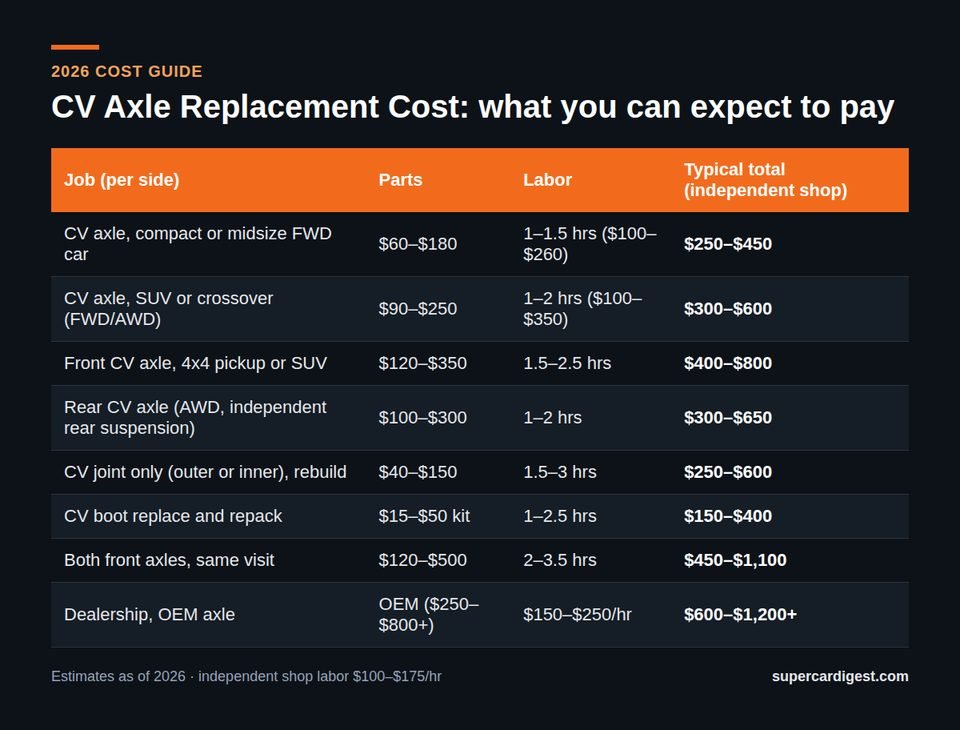
CV axle replacement cost in 2026 at a glance
| Job (per side) | Parts | Labor | Typical total (independent shop) |
|---|---|---|---|
| CV axle, compact or midsize FWD car | $60–$180 | 1–1.5 hrs ($100–$260) | $250–$450 |
| CV axle, SUV or crossover (FWD/AWD) | $90–$250 | 1–2 hrs ($100–$350) | $300–$600 |
| Front CV axle, 4×4 pickup or SUV | $120–$350 | 1.5–2.5 hrs | $400–$800 |
| Rear CV axle (AWD, independent rear suspension) | $100–$300 | 1–2 hrs | $300–$650 |
| CV joint only (outer or inner), rebuild | $40–$150 | 1.5–3 hrs | $250–$600 |
| CV boot replace and repack | $15–$50 kit | 1–2.5 hrs | $150–$400 |
| Both front axles, same visit | $120–$500 | 2–3.5 hrs | $450–$1,100 |
| Dealership, OEM axle | OEM ($250–$800+) | $150–$250/hr | $600–$1,200+ |
Many cars also need a wheel alignment afterward if the shop separates the lower ball joint or tie rod. Budget $100–$200 for that if your shop recommends it.
What a CV axle, CV joint and CV boot actually are
A CV (constant velocity) axle is the shaft that carries power from the transmission or differential to a wheel while the suspension moves up and down and the front wheels steer. Each axle has two CV joints: an outer joint at the wheel, which handles steering angles, and an inner joint at the transmission, which lets the axle change length as the suspension travels.
Each joint is packed with grease and sealed by a flexible rubber or plastic CV boot. The boot is the weak point. When it cracks or a clamp slips, grease flies out, dirt and water get in, and the joint wears out within weeks or months.
This is why CV joint replacement cost searches often end at a full axle quote. Taking a joint apart, cleaning it, and installing a new joint and boot takes about as long as swapping the whole shaft, and a new aftermarket axle comes with two fresh joints and two fresh boots. Unless your vehicle has a rare or expensive axle, replacing the assembly is usually the better deal.
Signs of a bad CV axle or CV joint
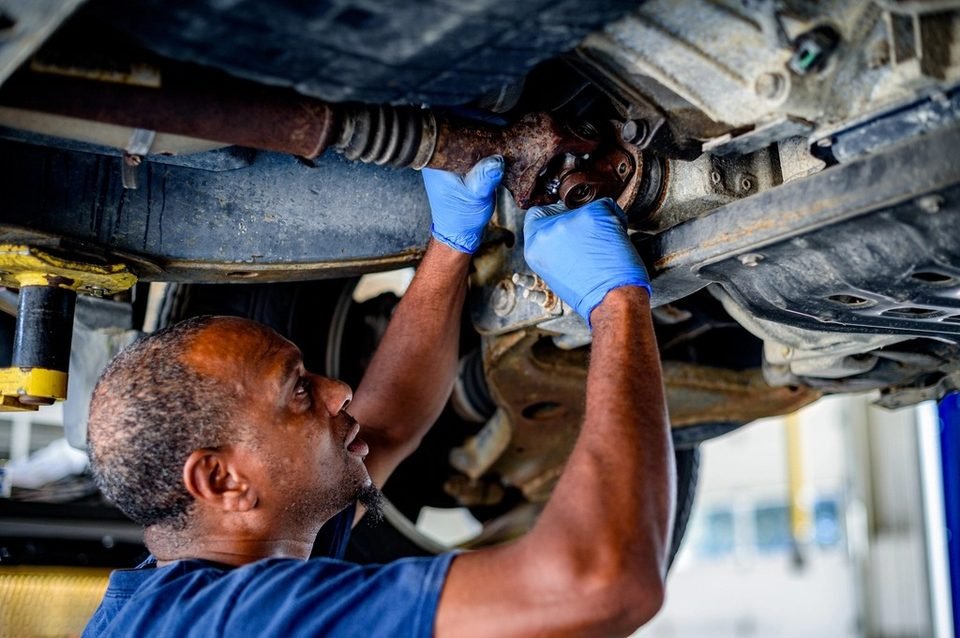
- Clicking or popping when turning, especially in parking lots or tight turns. This is the classic sign of a worn outer CV joint.
- Grease on the inside of the wheel, the tire sidewall or suspension parts, flung from a torn boot.
- Vibration while accelerating that eases when you coast, often a worn inner joint.
- Clunking when shifting into drive or reverse, or when you get on and off the gas.
- A visibly torn, split or loose boot when you look behind the front wheel.
Some of these noises overlap with worn ball joints, tie rods or wheel bearings. If the clicking only happens in turns and goes away when you drive straight, the CV joint is the likely cause. A humming that rises with speed points more to a wheel bearing. Our car suspension repair cost guide covers those parts.
Catch the boot, save the axle
A torn boot with a quiet joint is the cheapest moment to act. Ask your shop to look at the CV boots at every oil change or tire rotation. If you see fresh grease on the inside of a wheel, get it checked within a week or two.
Is it safe to drive with a bad CV axle?
For a short time, usually yes. A torn boot with no noise can often go a few weeks before the joint is damaged, but every mile lets in more grit. A clicking joint is already worn; many cars keep clicking for months, but there is no safe number of miles to count on.
The real risk is a joint that comes apart. When that happens, the car loses drive to that wheel and may not move at all. In rare cases a broken axle can flail and damage brake lines, the ABS sensor wiring or the transmission seal.
One more thing many drivers don’t expect: with a broken front axle, shifting into Park may not hold the car, because the open differential lets the broken side spin freely. Set the parking brake and have the car towed.
Stop driving if you notice these
Heavy vibration that gets worse with speed, loud clunks under acceleration, or a grinding noise from one side mean the joint may be close to failing. Get it to a shop gently, avoid the highway, and consider a tow if the noise is constant.
What drives the price up or down
1. Vehicle type and drivetrain
Compact front-wheel-drive cars have cheap, easy-to-reach axles. Four-wheel-drive pickups, AWD SUVs and European cars use longer or heavier axles and can need extra disassembly, such as removing a hub nut that requires a large socket and serious torque.
2. Aftermarket vs. OEM axle
New aftermarket axles are widely available for $60–$250 and usually carry a limited lifetime warranty from the parts store. OEM axles from a dealer often cost $250–$800 or more. Quality varies: some very cheap axles can cause a vibration on certain vehicles, so a mid-priced brand or OEM part is worth it if your car is known to be picky.
In practice there are three tiers:
- OEM or OEM-supplier axles ($250–$800+): made by the companies that supply the automakers, such as GKN, NTN or Aisin depending on the brand. Buying the supplier’s box online instead of the dealer’s box is often noticeably cheaper for the same part.
- New aftermarket axles ($60–$250): brands like GSP, TrakMotive or Cardone. Fine for most commuters and usually backed by a store warranty.
- Remanufactured axles ($80–$200 plus a core deposit): original shafts with new joints or boots. Quality depends heavily on the rebuilder.
A common complaint with the cheapest axles is a vibration at idle in Drive or under light acceleration. Some factory axles carry a small rubber damper weight on the shaft and use tighter inner-joint tolerances; budget copies may skip that. Owners of some Honda, Acura and Subaru models report this most often, so on those cars an OEM-supplier axle is usually the safer buy.
3. Rust and seized parts
In snowy states, axles can seize in the wheel hub and ball joints can refuse to separate. That can add an hour or more of labor. If the shop also finds a worn ball joint or a leaking transmission seal, those are added to the bill but are cheaper to fix while everything is apart.
4. One side or both
Axles do not have to be replaced in pairs. But if both boots are cracked on a high-mileage car, doing both sides together saves on setup time and may get you a small labor discount.
5. Driver side vs. passenger side
On many front-wheel-drive cars with a sideways-mounted engine, the passenger-side axle is longer and uses an intermediate shaft with a support bearing bolted to the engine. That side can cost a little more in parts, and a rusted support bracket can add labor.
Dealer vs. independent shop vs. DIY
| Option | Typical cost per side | Pros | Cons |
|---|---|---|---|
| Dealership | $600–$1,200+ | OEM axle, factory-trained techs | Highest labor rate and parts markup |
| Independent shop | $250–$700 | Fair labor rate, choice of parts | Quality of aftermarket axle varies |
| Chain shop | $250–$650 | Quick, often coupons | Upselling is common |
| DIY | $60–$250 in parts | Lowest cost | Needs a large axle-nut socket, torque wrench, possibly a pickle fork or puller |
DIY is doable for a careful home mechanic on many FWD cars. The hard parts are breaking loose the axle nut, popping the inner joint out of the transmission without damaging the seal, and torquing everything correctly. Expect to lose a little transmission fluid and top it off.
How to pay less without cutting corners
- Fix a torn boot early. A $150–$400 boot job is much cheaper than an axle plus possible collateral damage.
- Ask for a quality aftermarket axle with a lifetime warranty rather than an OEM part on an older car.
- Replace the transmission output seal while the axle is out. It is a cheap part and takes a few minutes during the job, and it can prevent a fluid leak a few weeks later.
- Get two quotes, one from an independent shop. This is routine work that does not need a dealer.
- Bundle related work. If a ball joint, tie rod or seal is also worn, doing it now avoids paying the same labor twice.
- Check your coverage. Axles are usually covered under powertrain warranties and many extended plans. See are extended car warranties worth it?
When to walk away from the repair
A CV axle is rarely a reason to give up on a car. Even at $700, it is modest compared with most drivetrain repairs. The math changes when a clicking axle is one item on a long list, such as an oil leak, worn suspension and a tired transmission. Add up every repair and compare the total with the car’s value. Our guide on whether it’s worth fixing an old car explains the 50% rule.
If you are shopping for a used car, crouch down and look behind the front wheels. Grease spray or a torn boot is an easy negotiating point. Our used car inspection checklist covers what else to look for.
Useful on Amazon for this job
- Front CV axle (search by your vehicle)
- Axle nut socket set
- Click-type torque wrench (1/2 in.)
- Jack stands (3-ton pair)
As an Amazon Associate we earn from qualifying purchases. Always confirm fit for your exact vehicle or ask your dentist.
Super Car Digest · $14
The Used Car Buying Playbook
Big repair bill on an older car? Before you pay for it, run the numbers on replacing the car — and if you do switch, don’t overpay for the next one. Budget worksheet, 15-minute VIN screen, test-drive routine, word-for-word negotiation scripts and a 10-point contract check.
Frequently asked questions
How much does it cost to replace a CV axle?
About $250–$700 per side at an independent shop and $600–$1,200 or more at a dealer. Estimates as of 2026.
How much does a CV joint replacement cost?
Rebuilding a single CV joint usually runs $250–$600 because of the labor involved. On most cars, replacing the whole axle costs about the same and gives you two new joints, so that is what most shops recommend.
How much does it cost to replace a CV boot?
Typically $150–$400 per boot, including cleaning and repacking the joint with fresh grease. It only makes sense if the joint is not yet noisy.
How long can you drive with a clicking CV joint?
Some cars click for months, but there is no safe guarantee. The joint is already worn and can fail without much warning. Plan the repair within a few weeks.
How long does a CV axle last?
Many original axles last 80,000–150,000 miles or more. Most failures start with a torn boot, not normal wear of the joint itself.
Do CV axles need to be replaced in pairs?
No. Each side can be replaced on its own. Doing both makes sense only when both are worn or both boots are cracked.
Do you need an alignment after a CV axle replacement?
Not always. If the shop only separates the lower ball joint or tie rod to swing the knuckle out, alignment angles usually do not change. If the strut-to-knuckle bolts are removed, an alignment ($100–$200) is a good idea.
Is it a bad CV joint or a bad wheel bearing?
A bad CV joint usually clicks or pops in tight turns or shudders only while accelerating. A bad wheel bearing makes a steady hum or growl that rises with speed, even when coasting. A shop can confirm with a quick test drive and a lift inspection.
Why does my new CV axle vibrate?
Cheaper aftermarket axles sometimes lack the damper weight or tolerances of the factory part, and some cars are sensitive to that. Also check that the axle is fully seated and the axle nut is torqued correctly. If the vibration stays, many owners solve it by switching to an OEM-supplier axle.
Sources and methodology
Price ranges combine 2026 estimates from the RepairPal estimator for CV axle and CV boot replacement, published labor-time guides, current retail pricing for aftermarket and OEM axles, and labor at typical 2026 shop rates ($100–$175/hr independent, $150–$250/hr dealer; AAA has reported national averages around $140/hr). These are estimates; your quote will vary by vehicle, region and condition.