Key takeaways
- A check engine light flashing means the engine computer has detected a severe misfire that can overheat and damage the catalytic converter.
- Ease off the gas right away. If the car is shaking, losing power or smells like fuel, pull over safely and stop driving.
- The most common causes are a bad ignition coil or spark plug, usually a $150–$450 repair at an independent shop.
- Ignoring it can turn a cheap fix into a $1,000–$3,000+ catalytic converter replacement.
- Estimates as of 2026; your price depends on the vehicle, the cause and local labor rates ($100–$175/hr independent, $150–$250/hr dealer).
A check engine light flashing on your dashboard means your engine is misfiring badly enough that unburned fuel is being pushed into the exhaust, where it can overheat and destroy the catalytic converter. It is the most urgent version of the check engine light. Reduce your speed, avoid hard acceleration, and if the car is shaking or losing power, stop driving and arrange a tow or a short, gentle trip to a shop. In most cases the cause is a worn spark plug or a failed ignition coil, and the repair often costs $150–$450 at an independent shop. This guide explains what to do in the first few minutes, why the light sometimes flashes and then stops, the most common causes and what each one costs to fix in 2026.
📩 Important: after you sign up, open the email from Super Car Digest and tap Confirm. Your checklist opens right away. Not there? Check Spam or Promotions.
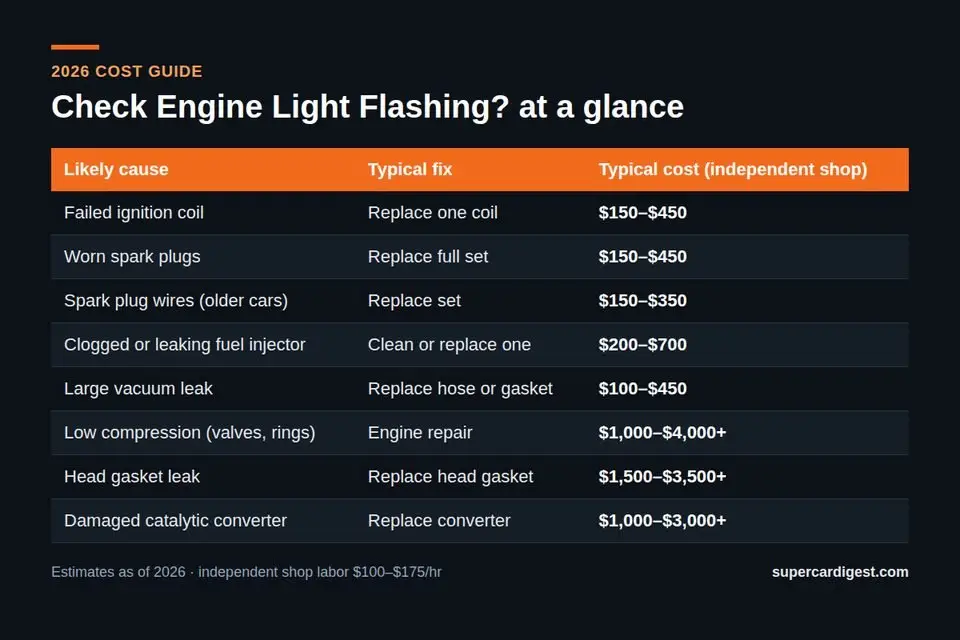
Flashing check engine light: common causes and costs
| Likely cause | Typical fix | Typical cost (independent shop) |
|---|---|---|
| Failed ignition coil | Replace one coil | $150–$450 |
| Worn spark plugs | Replace full set | $150–$450 |
| Spark plug wires (older cars) | Replace set | $150–$350 |
| Clogged or leaking fuel injector | Clean or replace one | $200–$700 |
| Large vacuum leak | Replace hose or gasket | $100–$450 |
| Low compression (valves, rings) | Engine repair | $1,000–$4,000+ |
| Head gasket leak | Replace head gasket | $1,500–$3,500+ |
| Damaged catalytic converter | Replace converter | $1,000–$3,000+ |
Most shops charge $100–$180 for a diagnostic, and many apply it to the repair if you have the work done there. Some parts stores will read your codes for free, which tells you which cylinder is misfiring but not always why.
What to do right now if your check engine light is flashing
- Ease off the throttle. Misfires get worse under load. Drive gently, avoid passing and steep hills, and do not tow anything.
- Check how the car feels. If it is shaking hard, stumbling, losing power or the light stays flashing at a steady cruise, find a safe place to pull over.
- Look and smell. A strong raw-fuel or rotten-egg smell, or a glowing or smoking area under the car, means the converter may be overheating. Turn the engine off and move away from dry grass.
- Do not keep restarting and revving to “clear it out.” That only sends more fuel into the exhaust.
- Get the codes read as soon as possible, and plan a repair before driving any real distance.
When to stop driving
Pull over and call for a tow if the car shakes badly, will not hold speed, smells strongly of fuel, or you see smoke. A severe misfire can overheat the catalytic converter to the point where it becomes a fire risk, especially if you park over dry grass or leaves. Get off the highway and keep a safe distance from traffic while you wait.
Why a flashing light is different from a steady one
A steady check engine light means the computer has stored a fault that affects emissions. It could be anything from a loose gas cap to a failing oxygen sensor. You should get it checked soon, but it is usually not an emergency. Our guide to a check engine light caused by a loose gas cap covers the most common harmless case.
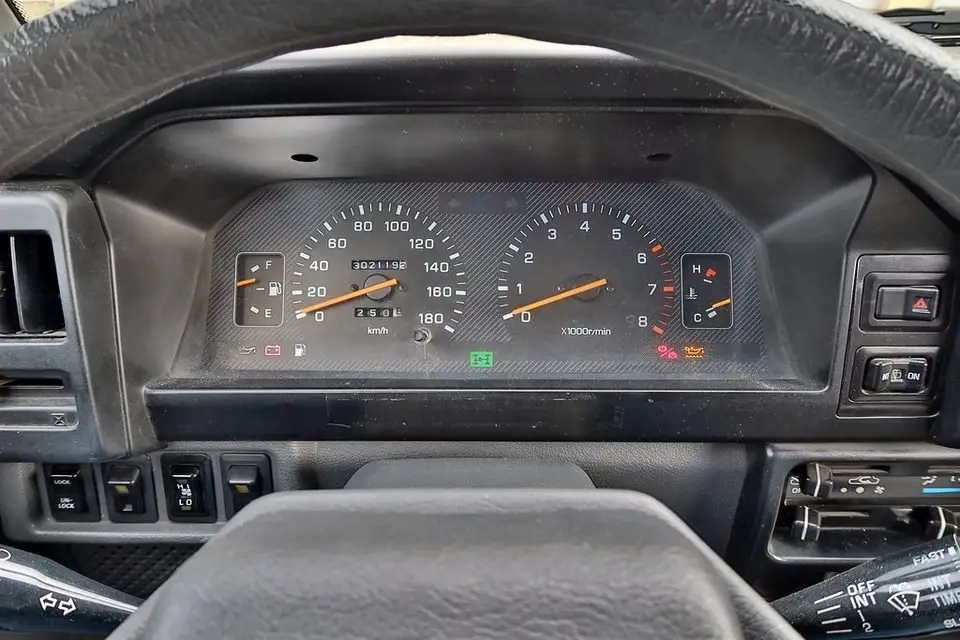
A flashing or blinking check engine light is reserved for one main problem: a misfire bad enough to damage the catalytic converter. When a cylinder does not fire, the fuel injected into it goes straight into the exhaust. The converter burns that fuel, and its temperature can climb far above normal. A few minutes of heavy misfiring can melt the honeycomb inside, which then restricts the exhaust and makes the engine run even worse.
Why is my check engine light flashing and then stops?
This is common. The computer flashes the light only while the misfire rate is above a damaging threshold. When you lift off the gas, slow down or the engine warms up, the misfire may become less frequent and the light goes back to steady or off. That does not mean the problem fixed itself. An ignition coil that is breaking down, a plug with a worn electrode or a weak injector often misfire only under load or in damp weather. The stored code will still be there, and the next hard acceleration can bring the flashing back.
Check engine light flashing and car shaking
If the engine shakes at idle or bucks when you accelerate, at least one cylinder is not firing. You can feel the imbalance through the seat and steering wheel. This combination is the clearest signal to stop driving. Continuing at highway speed is how a $200 coil replacement becomes a converter job.
How to read the codes
Every car sold in the US since 1996 has an OBD2 port, usually under the dashboard near the driver’s knees. A basic scanner costs $20–$60, and Bluetooth readers that work with a phone app cost about the same. Many auto parts stores will scan your car for free.
Misfire codes follow a simple pattern:
- P0300 means random or multiple-cylinder misfire. Look for something shared by all cylinders: a vacuum leak, low fuel pressure, a bad sensor or worn plugs across the board.
- P0301 to P0308 point to a specific cylinder. P0302 is cylinder 2, P0304 is cylinder 4, and so on.
- P0420 or P0430 alongside misfire codes can mean the converter is already damaged.
- Fuel trim codes such as P0171 or P0174 (system too lean) often point to a vacuum leak or fuel delivery problem.
A simple trick a shop or a careful DIYer can use: on engines with one coil per cylinder, swap the coil from the misfiring cylinder with a neighbor, clear the code, and drive. If the misfire moves to the new cylinder, the coil is bad. If it stays put, look at the spark plug or injector. Do not clear codes before you write them down, and see our guide on how to reset a check engine light for why clearing codes can hide a problem.
The most common causes, explained
1. Ignition coils
Most modern engines have one coil sitting on top of each spark plug. Heat and age break down the insulation, and a failing coil may work fine at idle but misfire under load. Replacing one coil usually costs $150–$450; see our ignition coil replacement cost guide for details by engine type.
2. Spark plugs
Worn plugs need more voltage to fire, which also stresses the coils. Many modern plugs are rated for around 60,000 to 100,000 miles, but if yours are overdue, replace the full set. Our spark plug replacement cost guide covers four-, six- and eight-cylinder engines.
3. Fuel injectors
A clogged injector starves one cylinder of fuel, while a leaking one floods it. Direct-injection engines have higher-pressure injectors that cost more to replace.
4. Vacuum leaks
A cracked hose, a failed intake gasket or a stuck PCV valve can let unmetered air in, causing lean misfires that often show up as P0300. A failed PCV valve is a cheap fix that is easy to overlook.
5. Mechanical problems
If coils, plugs and injectors check out, a compression or leak-down test can reveal a burned valve, worn rings or a head gasket leaking coolant into a cylinder. A misfire on a cold start with white exhaust smoke is a classic head gasket clue.
How to avoid a catalytic converter bill
- Act fast. The converter is damaged by heat over time. Fixing a misfire within a day or two is much safer than driving on it for weeks.
- Keep up with spark plugs at the interval in your owner’s manual.
- Do not ignore a rough idle or a steady check engine light with misfire codes. Flashing is often the second stage.
- Fix oil and coolant consumption. Oil or coolant burning in the cylinders can foul plugs and coat the converter.
- Use the right parts. Cheap coils and plugs that do not match the original specification can cause repeat misfires.
If the converter is already damaged and the car is old, compare the total bill with what the car is worth. Our repair or replace calculator helps you decide.
Useful on Amazon for this job
As an Amazon Associate we earn from qualifying purchases. Always confirm fit for your exact vehicle or ask your dentist.
Advice from the shop floor
- Ignition coils and plugs are the usual suspects on many engines, especially turbocharged ones that put more load on the spark.
- Be careful with cheap or fake coils. Counterfeit parts in brand-name boxes are sold online. Buy from a trusted parts store or dealer.
- Replace worn spark plugs with the coil. Worn plugs make coils work harder and can cause the new coil to fail.
- Check for oil in the plug wells, which can point to a leaking valve cover or tube seal causing the misfire.
- Some misfires are mechanical, such as lifter problems on some GM V8s with cylinder deactivation. A compression or leak-down test can tell a mechanical problem from an ignition one.
- Don’t accept a converter quote without testing. A good shop fixes the misfire first and then checks whether the catalytic converter was actually damaged.
Driving on it can cost you the converter
Emissions warranties may cover a catalytic converter that failed from a defect, but damage from driving long distances with a flashing light can be denied. Pull over safely and arrange a tow if the light keeps flashing.
Super Car Digest · $14
The Used Car Buying Playbook
Big repair bill on an older car? Before you pay for it, run the numbers on replacing the car — and if you do switch, don’t overpay for the next one. Budget worksheet, 15-minute VIN screen, test-drive routine, word-for-word negotiation scripts and a 10-point contract check.
Frequently asked questions
Can I drive with a flashing check engine light?
Only gently and only as far as necessary. If the car is shaking, losing power or smells of fuel, stop and have it towed. Every mile with a severe misfire risks damaging the catalytic converter.
What does a blinking check engine light mean?
It means the engine computer has detected a misfire severe enough to damage the catalytic converter. A steady light is a less urgent fault.
How much does it cost to fix a flashing check engine light?
Most cases are a coil or spark plugs at $150–$450. Injector and vacuum leak repairs often run $100–$700, and engine or converter damage can reach $1,000–$4,000 or more. Estimates as of 2026.
Can low oil or bad gas cause a flashing check engine light?
Contaminated or very low-quality fuel can cause misfires. Low oil alone rarely triggers a flashing light, but on some engines it can affect variable valve timing and cause rough running. Check the oil level either way.
Will the flashing light go away on its own?
It may stop flashing when the misfire eases, but the cause is still there. The code stays stored until it is repaired or cleared.
Sources and methodology
Price ranges combine 2026 estimates from the RepairPal estimator for ignition, fuel and exhaust repairs, standard OBD2 diagnostic code definitions, published labor-time guides, current retail pricing for aftermarket and OEM parts, and labor at typical 2026 shop rates ($100–$175/hr independent, $150–$250/hr dealer; AAA has reported national averages around $140/hr). These are estimates; your quote will vary by vehicle, region and condition.