Key takeaways
- The best way to reset a check engine light is to fix the cause, then clear the code with an OBD2 scanner ($20–$60) or let the car turn the light off by itself.
- Disconnecting the battery also clears codes, but it can erase radio presets, idle and window settings and may require relearn steps.
- Clearing codes resets your emissions readiness monitors. Go for an inspection right after a reset and you will likely fail or be turned away.
- If the cause is still there, the light comes back, often within one or a few drives.
- Never just clear a flashing check engine light. That signals a severe misfire that needs repair.
To reset a check engine light, plug an OBD2 scanner into the port under your dashboard, read and write down the code, fix the problem, then choose “clear codes” or “erase DTCs” on the scanner. If the fault was minor, such as a loose gas cap, the car will often turn the light off on its own after several normal drives. Disconnecting the battery also works on many cars, but it erases other settings and is a blunt tool. Clearing the light without fixing the cause only hides the problem: it will come back, and your car will not be ready for an emissions inspection until it completes its self-tests again. This guide walks through each method, explains readiness monitors and lists the situations where you should not reset the light at all.
📩 Important: after you sign up, open the email from Super Car Digest and tap Confirm. Your checklist opens right away. Not there? Check Spam or Promotions.
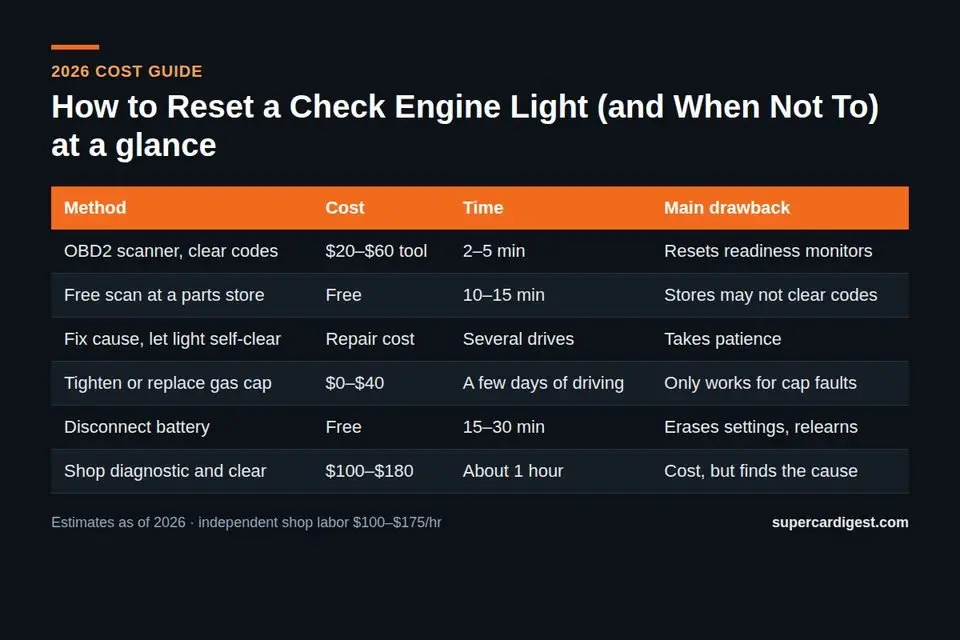
Ways to reset a check engine light compared
| Method | Cost | Time | Main drawback |
|---|---|---|---|
| OBD2 scanner, clear codes | $20–$60 tool | 2–5 min | Resets readiness monitors |
| Free scan at a parts store | Free | 10–15 min | Stores may not clear codes |
| Fix cause, let light self-clear | Repair cost | Several drives | Takes patience |
| Tighten or replace gas cap | $0–$40 | A few days of driving | Only works for cap faults |
| Disconnect battery | Free | 15–30 min | Erases settings, relearns |
| Shop diagnostic and clear | $100–$180 | About 1 hour | Cost, but finds the cause |
Whichever method you use, write down the code first. Once it is cleared, the stored information about when and how the fault happened (called freeze frame data) is gone too, and that information helps a mechanic later.
Method 1: Clear the code with an OBD2 scanner
Every car and light truck sold in the US since the 1996 model year has an OBD2 port. It is a 16-pin connector, usually under the dashboard on the driver’s side, sometimes behind a small cover.
- Turn the car off and plug the scanner into the port.
- Turn the key to “on” without starting the engine, or press the start button twice without your foot on the brake on most push-button cars.
- Read the codes. Write down every code and its description. Take a photo of the freeze frame screen if your tool shows it.
- Fix the cause or confirm it was something simple, like a loose gas cap.
- Select “Erase” or “Clear codes” and confirm. The light should go off.
- Start the car and make sure the light stays off. Check again after a few drives.
Basic handheld code readers and Bluetooth dongles that pair with a phone app cost about $20–$60 and do this job well. More expensive scanners add live data, which helps you check sensors such as oxygen sensors and fuel trims.
Method 2: Let the car clear it on its own
You do not always need a tool. The engine computer keeps testing the system that set the code. If the fault does not return after a number of drive cycles, the computer turns the light off by itself. The exact number varies by manufacturer and by fault, but it often takes three or more trips with a cold start and a mix of city and highway driving. The code may stay in memory as a history code for a while, which is normal.
This is the usual path after a gas cap problem. Tighten the cap until it clicks, drive normally for a few days, and the light usually goes off. Our guide to the check engine light and a loose gas cap explains the codes and timing.
Method 3: Disconnect the battery (with caveats)
On many cars, removing power from the engine computer clears stored codes. Disconnect the negative battery cable, wait 15 minutes or so, then reconnect it firmly. Some vehicles hold their memory longer and may need more time.
Before you pull the battery cable
Wear eye protection, remove the negative terminal first and keep tools away from the positive terminal. Many cars lose radio presets and clock settings, some radios ask for an anti-theft code, power windows and sunroofs may need to be re-initialized, and the engine may idle oddly for a few drives while it relearns. On some newer vehicles, battery disconnection also requires steering angle or throttle relearn procedures. Check your owner’s manual first.
Because of these side effects, a $20 scanner is usually the better choice. It clears codes without touching the rest of the car’s memory.
Why the check engine light comes back
Clearing a code does not repair anything. It only tells the computer to start testing again. If the fault is still present, the computer detects it and turns the light back on. Some faults reappear on the next drive. Others, especially EVAP leak tests, only run under specific conditions such as a certain fuel level and outside temperature, so the light may stay off for days before returning.
Common reasons the light returns after a reset:
- A failing oxygen sensor or catalytic converter efficiency fault. See our O2 sensor replacement cost guide.
- A misfire from a worn spark plug or ignition coil.
- A sticking EGR valve or clogged EGR passages. Our EGR valve replacement cost guide covers this repair.
- An EVAP leak somewhere other than the gas cap, such as a purge valve or cracked hose.
- A vacuum leak that causes a lean code.
Readiness monitors: why resetting before an inspection backfires
Your car runs a set of self-tests, called readiness monitors, for systems like the catalytic converter, oxygen sensors, EVAP system and misfire detection. When you clear codes, by scanner or by battery disconnect, every monitor resets to “not ready.”
States that use OBD2 emissions testing check these monitors. If too many are not ready, the car is rejected or fails, even with the light off. Inspectors see a just-cleared computer immediately, so a reset before a test does not hide anything.
To get monitors ready, drive normally for several days, including cold starts, steady highway cruising and some stop-and-go traffic. Many scanners show monitor status so you can check before your appointment. The rules on how many incomplete monitors are allowed vary by state and model year, so check with your state’s emissions program.
When you should not reset the light
- The light is flashing. That means a severe misfire. Read our guide on a flashing check engine light and get it repaired.
- The car runs badly, overheats, loses power or makes new noises.
- You are about to see a mechanic. Leave the code and freeze frame data for them.
- You are selling the car. Clearing codes to hide a problem from a buyer is dishonest, and many buyers check monitor status.
- Other warning lights are on, such as oil pressure or temperature. Those need immediate attention.
Buying used? Check the monitors
A seller who cleared codes right before you arrive will leave several monitors “not ready.” Bring a cheap scanner to every test drive. Our used car inspection checklist explains what else to look for.
Useful on Amazon for this job
As an Amazon Associate we earn from qualifying purchases. Always confirm fit for your exact vehicle or ask your dentist.
Super Car Digest · $14
The Used Car Buying Playbook
Big repair bill on an older car? Before you pay for it, run the numbers on replacing the car — and if you do switch, don’t overpay for the next one. Budget worksheet, 15-minute VIN screen, test-drive routine, word-for-word negotiation scripts and a 10-point contract check.
Frequently asked questions
How do I turn off the check engine light without a scanner?
Fix the cause and drive normally; the light often turns off by itself after several drive cycles. Disconnecting the battery also works on many cars, but it erases other settings and may need relearn steps.
Will AutoZone or other parts stores clear my check engine light?
Many parts stores read codes for free. Policies on clearing codes vary by store and state, so ask. Some will only read and explain the code.
How many miles until the check engine light resets itself?
There is no fixed mileage. It depends on drive cycles, not miles. Many faults clear after three or more trips that include a cold start and some steady driving, while EVAP faults can take longer.
Does clearing the code fail an emissions test?
It can. Clearing resets readiness monitors, and most OBD2 testing programs reject a car with too many incomplete monitors. Drive several days before testing.
How long should I disconnect the battery to reset the light?
Around 15 minutes works on many cars, though some take longer. A scanner is faster and does not erase your other settings.
Is it illegal to reset a check engine light?
Clearing codes on your own car is legal. Using a reset to mislead an inspector or a buyer is a different matter, and it rarely works because monitor status shows the reset.
Sources and methodology
Procedures reflect standard OBD2 functions required on US vehicles since the 1996 model year, general guidance from US EPA and state emissions-testing programs on readiness monitors, typical manufacturer owner’s manual guidance on battery disconnection, current retail pricing for code readers, and diagnostic fees at typical 2026 shop rates ($100–$175/hr independent, $150–$250/hr dealer; AAA has reported national averages around $140/hr). These are estimates; procedures and costs vary by vehicle and state.