Key takeaways
- A bolt-in ABS wheel speed sensor typically costs $100–$350 per wheel at an independent shop. Aftermarket sensors cost $25–$150; labor is usually 0.5–1.5 hours.
- If the sensor is built into the wheel hub, you replace the whole hub bearing assembly, which usually costs $250–$700 per wheel.
- Expect a diagnostic fee of $100–$175, since many basic code readers cannot read ABS codes.
- Dealers often charge $250–$600+ for a sensor with an OEM part, and more for hub-integrated designs.
- Estimates as of 2026; your price depends on the vehicle, sensor location and local labor rates ($100–$175/hr independent, $150–$250/hr dealer).
The ABS sensor replacement cost for most cars in 2026 is about $100 to $350 per wheel at an independent shop: roughly $25–$150 for an aftermarket wheel speed sensor and $50–$200 in labor. On vehicles where the sensor is built into the wheel hub, the job becomes a hub bearing replacement and usually costs $250–$700 per wheel. Dealers using OEM parts commonly charge $250–$600 or more. This guide explains what the ABS sensor does, why the ABS light comes on, which codes to look for, whether it is safe to drive, and how to keep the repair bill reasonable.
📩 Important: after you sign up, open the email from Super Car Digest and tap Confirm. Your checklist opens right away. Not there? Check Spam or Promotions.
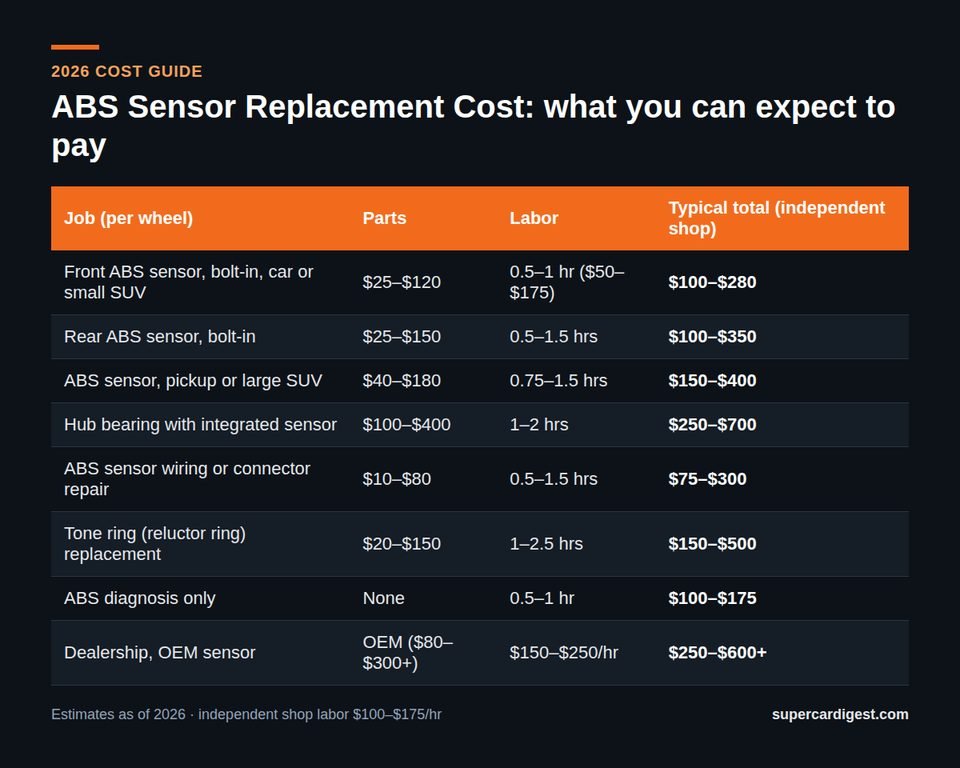
ABS sensor replacement cost in 2026 at a glance
| Job (per wheel) | Parts | Labor | Typical total (independent shop) |
|---|---|---|---|
| Front ABS sensor, bolt-in, car or small SUV | $25–$120 | 0.5–1 hr ($50–$175) | $100–$280 |
| Rear ABS sensor, bolt-in | $25–$150 | 0.5–1.5 hrs | $100–$350 |
| ABS sensor, pickup or large SUV | $40–$180 | 0.75–1.5 hrs | $150–$400 |
| Hub bearing with integrated sensor | $100–$400 | 1–2 hrs | $250–$700 |
| ABS sensor wiring or connector repair | $10–$80 | 0.5–1.5 hrs | $75–$300 |
| Tone ring (reluctor ring) replacement | $20–$150 | 1–2.5 hrs | $150–$500 |
| ABS diagnosis only | None | 0.5–1 hr | $100–$175 |
| Dealership, OEM sensor | OEM ($80–$300+) | $150–$250/hr | $250–$600+ |
Some shops apply the diagnostic fee toward the repair if you have the work done there. Ask about this before you approve the diagnosis.
What an ABS sensor actually does
An ABS sensor, also called a wheel speed sensor, sits at each wheel and reads a toothed or magnetic tone ring that spins with the hub or axle. It sends a signal to the ABS computer telling it how fast that wheel is turning. Most modern cars have four sensors, one per wheel.
The anti-lock brake system uses these signals to spot a wheel that is about to lock under hard braking and pulse the brakes on that wheel. The same sensors also feed traction control, stability control and, on many cars, the speedometer, the transmission and the tire pressure warning system. That is why one bad sensor can light up several warnings at once.
Bolt-in vs. hub-integrated sensors
On many cars, the sensor is a small part held in the knuckle with one bolt and connected by a cable. That is the cheap repair. On others, especially many front-wheel-drive cars and some trucks, the sensor is part of the wheel hub bearing assembly and cannot be bought separately. In that case the cost jumps to a full hub replacement. Ask the shop which type your vehicle has before comparing quotes.
Signs of a bad ABS sensor
- ABS warning light on the dash, often with the traction control or stability control light.
- Chassis trouble codes that start with “C,” such as C0035 for a left front wheel speed sensor circuit on many GM vehicles. Code meanings vary by make.
- ABS activating at low speed, with pulsing in the pedal when you are not braking hard.
- Speedometer that jumps or drops to zero on some vehicles.
- Harsh or odd shifting on cars where the transmission uses wheel speed data.
- Damaged sensor wire visible near the wheel, often after suspension, brake or axle work.
The sensor is not always the problem. A cut wire, a corroded connector, rust buildup under the sensor, or a cracked tone ring can trigger the same codes. A worn wheel bearing with too much play can also confuse the sensor. A good shop checks the signal with a scan tool before replacing parts.
Use a scanner that reads ABS codes
Many cheap OBD2 code readers only read engine codes. If the ABS light is on and your reader shows nothing, that does not mean nothing is wrong. Some auto parts stores and mid-priced scan tools can read ABS codes and show live wheel speeds.
Is it safe to drive with the ABS light on?
Usually, for a short time, if only the ABS light is on. Your regular brakes still work. What you lose is the anti-lock function, and often traction and stability control as well. On wet, icy or gravel roads, the wheels can lock and the car can skid in a hard stop. Leave more following distance and brake gently until it is fixed.
A failed ABS system can also cause a failed safety inspection in some states, and on some vehicles it affects cruise control or the speedometer.
Stop driving if you notice these
A red brake warning light together with the ABS light, a soft or sinking brake pedal, grinding noises or a burning smell point to a problem with the brakes themselves, not just a sensor. Pull over safely and have the car checked or towed.
What drives the price up or down
1. Sensor design
A bolt-in sensor is a small, cheap part. A hub-integrated sensor turns a $150 job into a $250–$700 job per wheel, since you are paying for a new bearing too.
2. Rust and seized sensors
In snowy states, sensors often seize in the knuckle and break when removed. The shop may need to drill out the old sensor or clean the bore, adding 30 minutes to an hour or more.
3. Aftermarket vs. OEM
Aftermarket sensors cost $25–$150 and work well on most cars. Some vehicles are picky about sensor signals, and a cheap sensor can bring the light back. On those, an OEM or major-brand sensor is worth the extra money.
4. Diagnosis time
Intermittent problems, such as a wire that breaks only when the suspension moves, can take longer to find. Wiring repairs are cheap in parts but can take an hour or more.
Dealer vs. independent shop vs. DIY
| Option | Typical cost per wheel | Pros | Cons |
|---|---|---|---|
| Dealership | $250–$600+ | OEM sensor, factory scan tools | Highest labor rate and parts markup |
| Independent shop | $100–$350 | Fair labor rate, choice of parts | Diagnosis quality varies |
| Chain shop | $120–$400 | Quick, often coupons | Upselling on brakes is common |
| DIY | $25–$150 in parts | Lowest cost | Needs an ABS-capable scanner; seized sensors can break |
A bolt-in sensor is one of the easier DIY jobs: remove the wheel, unbolt the sensor, route the new cable through the same clips and plug it in. The hard part is confirming which sensor is bad and freeing a rusted one without damaging the knuckle. Clear the codes afterward and test drive to confirm the light stays off.
How to pay less without cutting corners
- Get the exact code first. A free or low-cost ABS scan tells you which wheel to work on, so you do not replace the wrong sensor.
- Check the wiring and connector before buying a sensor. A $20 pigtail repair may fix it.
- Ask whether your sensor is bolt-in or hub-integrated so you can compare quotes fairly.
- Bundle related work. If you are already getting brakes, a wheel bearing or a CV axle on that corner, labor overlaps.
- Check your coverage. ABS parts are often included in bumper-to-bumper and some extended plans. See are extended car warranties worth it?
If you also have a tire pressure warning, note that some cars use ABS wheel speed data instead of separate sensors. Our TPMS sensor replacement cost guide explains the difference, and our O2 sensor replacement cost guide covers a common engine-side sensor repair.
When to walk away from the repair
An ABS sensor alone is almost never a reason to give up on a car. Even a $700 hub-integrated repair is modest. The math changes when the ABS light is one problem among many, such as a failing ABS control module, worn brakes, rusted lines and suspension work, on an older car with low value. Add up every repair and compare it with what the car is worth. Our guide on whether it’s worth fixing an old car explains the 50% rule, and the repair or replace calculator helps you run your own numbers.
If you are buying a used car, make sure the ABS light comes on at startup and then turns off. A light that never appears may have a bulb removed. Our used car inspection checklist covers more warning signs.
Useful on Amazon for this job
As an Amazon Associate we earn from qualifying purchases. Always confirm fit for your exact vehicle or ask your dentist.
Super Car Digest · $14
The Used Car Buying Playbook
Big repair bill on an older car? Before you pay for it, run the numbers on replacing the car — and if you do switch, don’t overpay for the next one. Budget worksheet, 15-minute VIN screen, test-drive routine, word-for-word negotiation scripts and a 10-point contract check.
Frequently asked questions
How much does it cost to replace an ABS sensor?
About $100–$350 per wheel at an independent shop for a bolt-in sensor, $250–$700 if it is built into the hub, and $250–$600 or more at a dealer. Estimates as of 2026.
Can I drive with a bad ABS sensor?
Usually for a short time, since normal braking still works. You lose anti-lock braking and often traction control, so drive carefully and fix it soon. Stop if the red brake light is also on.
What causes an ABS sensor to fail?
Common causes are damaged wiring, corrosion, rust buildup on the sensor tip, metal debris on the tone ring, and damage during brake or suspension work.
Will a bad ABS sensor cause a failed inspection?
In some states, yes. An illuminated ABS light can be a reason to fail a safety inspection. Check your state’s rules.
Should I replace ABS sensors in pairs?
No. Replace only the sensor that failed. Pairs make sense only if both sides are damaged or seized.
How long does ABS sensor replacement take?
Most bolt-in sensors take 30 minutes to an hour and a half. Hub-integrated designs usually take one to two hours per wheel.
Sources and methodology
Price ranges combine 2026 estimates from the RepairPal estimator for ABS wheel speed sensor and hub bearing replacement, published labor-time guides, current retail pricing for aftermarket and OEM sensors, and labor at typical 2026 shop rates ($100–$175/hr independent, $150–$250/hr dealer; AAA has reported national averages around $140/hr). These are estimates; your quote will vary by vehicle, region and condition.