Key takeaways
- A crankshaft position sensor replacement typically costs $120–$350 at an independent shop. The sensor costs $20–$150; labor is usually 0.5–1.5 hours.
- A camshaft position sensor is usually cheaper and easier to reach, at about $90–$300 installed.
- Hard-to-reach crank sensors, such as those behind the timing cover or above the transmission, can push the bill to $400–$700+.
- Codes P0335 (crank) and P0340 (cam), stalling when warm and intermittent no-starts are the classic signs.
- Estimates as of 2026; your price depends on the engine, part brand and local labor rates ($100–$175/hr independent, $150–$250/hr dealer).
The crankshaft sensor replacement cost for most cars in 2026 is about $120 to $350 at an independent shop: roughly $20–$150 for the sensor and $50–$250 in labor. Dealers using OEM parts commonly charge $250 to $600, and engines where the sensor is buried behind the timing cover or starter can run $400–$700 or more. Camshaft position sensor replacement cost is usually a bit lower, around $90–$300, because most cam sensors sit on top of the engine. This guide covers both sensors, codes P0335 and P0340, stalling and no-start symptoms, and how to avoid paying for parts you do not need.
📩 Important: after you sign up, open the email from Super Car Digest and tap Confirm. Your checklist opens right away. Not there? Check Spam or Promotions.
Crankshaft sensor replacement cost in 2026 at a glance
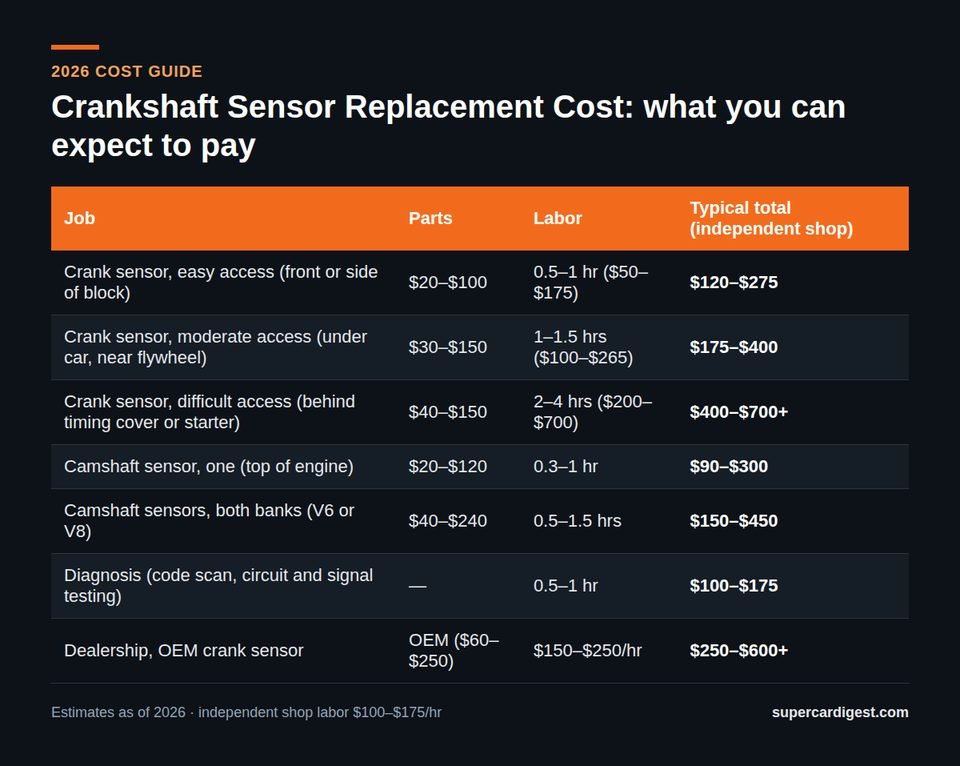
| Job | Parts | Labor | Typical total (independent shop) |
|---|---|---|---|
| Crank sensor, easy access (front or side of block) | $20–$100 | 0.5–1 hr ($50–$175) | $120–$275 |
| Crank sensor, moderate access (under car, near flywheel) | $30–$150 | 1–1.5 hrs ($100–$265) | $175–$400 |
| Crank sensor, difficult access (behind timing cover or starter) | $40–$150 | 2–4 hrs ($200–$700) | $400–$700+ |
| Camshaft sensor, one (top of engine) | $20–$120 | 0.3–1 hr | $90–$300 |
| Camshaft sensors, both banks (V6 or V8) | $40–$240 | 0.5–1.5 hrs | $150–$450 |
| Diagnosis (code scan, circuit and signal testing) | — | 0.5–1 hr | $100–$175 |
| Dealership, OEM crank sensor | OEM ($60–$250) | $150–$250/hr | $250–$600+ |
As with many sensors, the part is cheap. What changes the bill is how much has to come off to reach it.
What crankshaft and camshaft position sensors do
The crankshaft position sensor reads a toothed wheel, called a reluctor or tone ring, on the crankshaft or flywheel. It tells the engine computer how fast the engine is turning and exactly where each piston is. The computer uses that signal to fire the spark plugs and injectors. Without it, most engines will not start or will shut off while running.
The camshaft position sensor reads a target on the camshaft so the computer knows which stroke each cylinder is on. It is needed for sequential fuel injection and for variable valve timing. On many newer engines, a failed cam sensor causes rough running or limp mode, though some engines can still start on the crank signal alone.
Symptoms and trouble codes
- Stalling, often after the engine warms up, then restarting fine once it cools. Heat-related failure is common in crank sensors.
- Cranks but will not start, sometimes only now and then.
- Tachometer dropping to zero or jumping while driving.
- Misfires, hesitation or rough idle, and sometimes a shift into limp mode.
- Check engine light with P0335–P0339 for the crank sensor circuit or P0340–P0349 for the cam sensor circuit.
These symptoms overlap with other problems. A no-start can also be a weak starter motor, battery or fuel pump. Misfires can come from ignition coils or plugs. Cam sensor codes can also be set by a stretched timing chain or a cam-crank correlation problem, often logged with P0016–P0019. In that case, a new sensor will not fix it.
Note when it stalls
If the car dies when hot and restarts after 15–30 minutes, write that down and tell the shop. That pattern points strongly to a heat-sensitive crank sensor, and it helps the technician find it faster, which saves you diagnostic time.
Is it safe to drive with a bad crankshaft sensor?
Not really. A failing crankshaft sensor can shut off the engine without warning. When that happens at speed, you lose power assist for steering and, after a few presses, for the brakes. That is a real hazard in traffic or on a highway.
A bad cam sensor is usually less dramatic. The engine may run rough, lose power or go into limp mode, but many cars stay drivable. Still, it is not something to ignore for long, especially if it is masking a timing problem.
Stop driving if you notice these
Repeated stalling while moving, a tach that drops to zero while driving, or a flashing check engine light. Get the car to a shop on local roads, or have it towed if it stalls more than once.
Camshaft position sensor replacement cost
Most camshaft position sensors mount on the cylinder head or timing cover and are held by a single bolt, so the job often takes 20 minutes to an hour. Expect about $90–$300 at an independent shop for one sensor, and $150–$450 for both sensors on a V6 or V8 that has one per bank. Dealers often charge $200–$500.
A few engines tuck the cam sensor behind other parts, such as the intake plenum or engine cover brackets, which raises labor. On some engines with variable valve timing there are separate intake and exhaust cam sensors, and the code tells you which one is at fault.
Should you replace the crank and cam sensors together? Only if both are reported faulty or the car has a known pattern of both failing. Unlike some parts, these sensors do not need to be replaced in pairs.
What drives the price up or down
1. Sensor location
This is the biggest factor. Sensors on the front of the engine near the crank pulley are fast. Sensors near the flywheel may need the car on a lift and a heat shield removed. Some engines place the crank sensor behind the timing cover or require removing the starter or an axle, which adds hours.
2. Part quality
Cheap sensors are a common reason the problem comes back. A signal that is slightly off can cause misfires or a code that returns days later. An OEM or OE-supplier sensor costs more but is usually worth it.
3. Diagnosis
Intermittent stalling can take time to reproduce. Expect $100–$175 for diagnosis, sometimes more if the shop has to scope the signal. Damaged wiring, a cracked reluctor ring or oil in the connector all change the repair.
4. Dealer vs independent labor
For an easy sensor, the dealer’s higher rate adds maybe $50–$100. For a difficult one, it can add $200–$400.
Dealer vs. independent shop vs. DIY
| Option | Typical cost (crank sensor) | Pros | Cons |
|---|---|---|---|
| Dealership | $250–$600+ | OEM sensor, factory scan tools | Highest labor rate and parts markup |
| Independent shop | $120–$400 | Fair labor rate, good at diagnosis | Part brand quality varies |
| Chain shop | $150–$450 | Quick, often free code scan | Code scan is not a full diagnosis |
| DIY | $20–$150 in parts | Lowest cost on easy-access sensors | Hard to confirm the diagnosis without proper tools |
On many cars, a cam sensor and an easy crank sensor are fair DIY jobs: unplug, remove one bolt, install the new sensor with a light coat of oil on the O-ring, and clear the codes. Some engines then need a crank relearn procedure with a scan tool, so check before you start.
How to pay less without cutting corners
- Get a proper diagnosis. A code points to a circuit, not always a part.
- Buy a quality sensor. A $25 sensor that fails in a month costs more in the end.
- Ask about a relearn. Confirm the quote includes any crank relearn your car needs.
- Get two quotes for difficult-access sensors, where labor estimates vary the most.
- Check your coverage. Engine sensors are often covered by powertrain or extended warranties. See are extended car warranties worth it?
When to walk away from the repair
A crankshaft or camshaft sensor is almost never a reason to give up on a car. Even a difficult-access job is modest. The math changes when the cam code turns out to be a stretched timing chain on a high-mileage engine, or when the sensor is one of many big repairs. Add up everything and compare it with the car’s value. Our guide on whether it’s worth fixing an old car explains the 50% rule, and the repair or replace calculator helps you decide.
Useful on Amazon for this job
- Crankshaft position sensor (by vehicle)
- Camshaft position sensor (by vehicle)
- OBD2 scanner with live data
As an Amazon Associate we earn from qualifying purchases. Always confirm fit for your exact vehicle or ask your dentist.
Super Car Digest · $14
The Used Car Buying Playbook
Big repair bill on an older car? Before you pay for it, run the numbers on replacing the car — and if you do switch, don’t overpay for the next one. Budget worksheet, 15-minute VIN screen, test-drive routine, word-for-word negotiation scripts and a 10-point contract check.
Frequently asked questions
How much does it cost to replace a crankshaft position sensor?
About $120–$350 at an independent shop and $250–$600 or more at a dealer. Hard-to-reach sensors can cost $400–$700+. Estimates as of 2026.
How much does a camshaft position sensor replacement cost?
Usually $90–$300 for one sensor at an independent shop, and $150–$450 if both banks on a V6 or V8 need sensors.
What do codes P0335 and P0340 mean?
P0335 is a fault in the crankshaft position sensor A circuit. P0340 is a fault in the camshaft position sensor A circuit for bank 1. Both can be caused by the sensor, wiring or connector.
Can a bad crankshaft sensor cause a no-start?
Yes. Without a crank signal, most engines will crank but not start, because the computer does not know when to fire the spark plugs and injectors.
Why does my car stall when hot and restart when cool?
That is a classic sign of a failing crankshaft position sensor, though fuel pumps and ignition parts can do it too. Have the shop confirm before replacing parts.
How long does it take to replace a crank sensor?
Often 30 minutes to 1.5 hours. Sensors behind the timing cover or starter can take 2–4 hours.
Sources and methodology
Price ranges combine 2026 estimates from the RepairPal estimator for crankshaft and camshaft position sensor replacement, published labor-time guides, standard OBD-II code definitions, current retail pricing for aftermarket and OEM sensors, and labor at typical 2026 shop rates ($100–$175/hr independent, $150–$250/hr dealer; AAA has reported national averages around $140/hr). These are estimates; your quote will vary by vehicle, region and condition.