Key takeaways
- Replacing one rubber motor mount typically costs $200–$600 at an independent shop.
- Hydraulic mounts usually run $300–$800 each, and active or electronic mounts can reach $500–$1,200+ per mount.
- Most cars have three or four mounts, including the transmission mount. Replacing all of them is about $600–$1,500, or more on luxury and V6/V8 vehicles.
- A worn mount causes vibration and clunks; a broken one can let the engine shift enough to damage hoses, wiring and axles.
- Estimates as of 2026; your price depends on the vehicle, mount type and local labor rates ($100–$175/hr independent, $150–$250/hr dealer).
The motor mount replacement cost — also called the engine mount replacement cost — is roughly $200 to $600 per mount at an independent shop in 2026. Parts usually cost $40–$250 for a rubber or hydraulic mount, and labor runs $100–$400 depending on how hard the mount is to reach. Dealers often charge $400–$1,000 per mount. Replacing every mount on the car, including the transmission mount, usually lands between $600 and $1,500. Here’s what affects the price, how to tell a mount is failing, and whether you need to replace them all.
📩 Important: after you sign up, open the email from Super Car Digest and tap Confirm. Your checklist opens right away. Not there? Check Spam or Promotions.
Motor mount replacement cost in 2026 at a glance
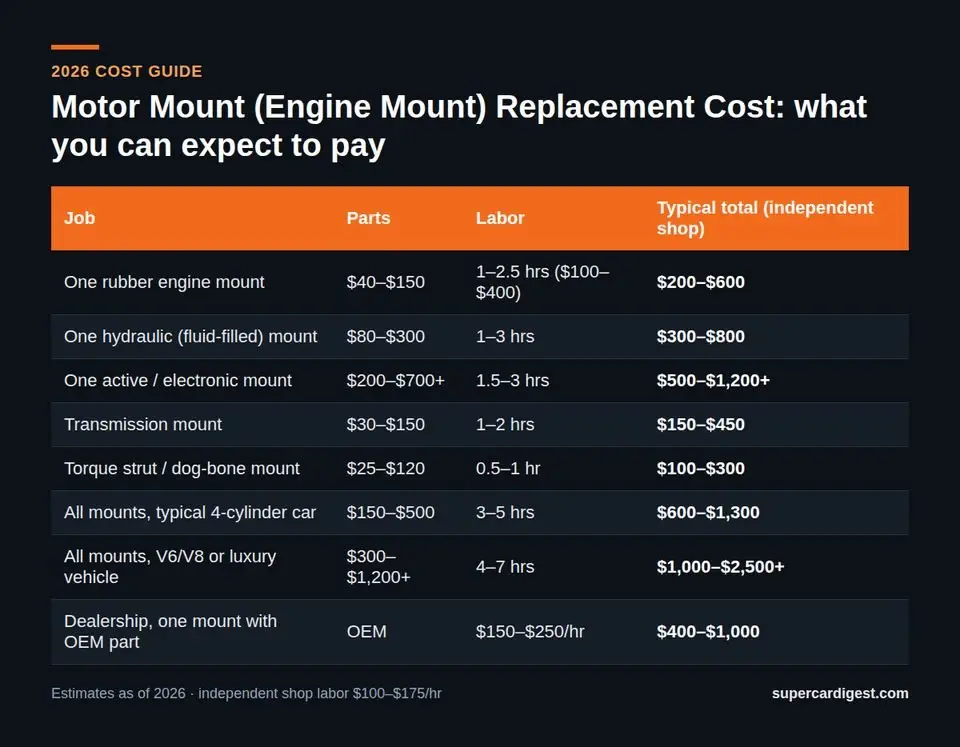
| Job | Parts | Labor | Typical total (independent shop) |
|---|---|---|---|
| One rubber engine mount | $40–$150 | 1–2.5 hrs ($100–$400) | $200–$600 |
| One hydraulic (fluid-filled) mount | $80–$300 | 1–3 hrs | $300–$800 |
| One active / electronic mount | $200–$700+ | 1.5–3 hrs | $500–$1,200+ |
| Transmission mount | $30–$150 | 1–2 hrs | $150–$450 |
| Torque strut / dog-bone mount | $25–$120 | 0.5–1 hr | $100–$300 |
| All mounts, typical 4-cylinder car | $150–$500 | 3–5 hrs | $600–$1,300 |
| All mounts, V6/V8 or luxury vehicle | $300–$1,200+ | 4–7 hrs | $1,000–$2,500+ |
| Dealership, one mount with OEM part | OEM | $150–$250/hr | $400–$1,000 |
What motor mounts do, and how many your car has
Motor mounts bolt the engine and transmission to the car’s frame or subframe. They hold the weight, stop the engine from twisting under power, and soak up vibration so you don’t feel every combustion pulse through the seat and steering wheel.
Most front-wheel-drive cars have three or four mounts: one or two engine mounts, a transmission mount and a torque strut (sometimes called a dog-bone mount) that controls rocking. Rear-wheel-drive trucks and cars usually have two engine mounts plus a transmission mount under the tailshaft. The transmission mount counts as part of the “mount set” because the engine and transmission move as one unit.
Rubber vs. hydraulic vs. active mounts
- Rubber mounts — a block of rubber bonded between two steel brackets. Cheapest and most common on older and economy cars.
- Hydraulic mounts — rubber with a fluid-filled chamber that damps vibration better. Common on many sedans and SUVs. When they fail, they often leak a dark, oily fluid.
- Active or electronic mounts — use a vacuum or electric actuator to change stiffness, often to smooth out cylinder deactivation or diesel idle. Found on many luxury cars, some V6/V8 trucks and hybrids. These cost the most.
Signs of a bad motor mount
- Excess vibration at idle, felt in the seat, steering wheel or pedals, often worse in Drive at a stop.
- Clunk or bang when shifting from Park to Drive or Reverse.
- Clunk when accelerating hard or letting off the gas, as the engine rocks.
- Engine visibly lifts or rocks when someone revs it lightly in gear with the brake held (a shop test).
- Cracked, separated or collapsed rubber, or fluid leaking from a hydraulic mount.
- Exhaust or hoses rubbing on the body, or a new rattle under the car.
- Check engine light or warning message on vehicles with active mounts.
Vibration at idle can also come from misfires, so rule those out first. A worn ignition coil or old spark plugs can make an engine shake in a way that feels a lot like a bad mount. A clunk on acceleration can also come from a worn CV axle.
Is it safe to drive with a bad motor mount?
A single worn mount usually isn’t an immediate danger. You can often drive for a few weeks while you get quotes, but the problem gets worse, not better. The other mounts take on extra load and wear faster.
A completely broken mount is more serious. The engine can move far enough to stretch or break radiator and heater hoses, pull on wiring and vacuum lines, damage the exhaust, and strain the axles. In rare, extreme cases on older vehicles, a shifting engine has interfered with the throttle linkage. If you hear loud bangs when shifting or see the engine jump, get it repaired right away.
Oil leaks kill mounts
Engine oil softens and swells rubber. If a valve cover or oil pan is leaking onto a mount, the new mount will fail early too. Fix the leak at the same time — see our car oil leak repair cost guide. A leaking coolant hose near a mount is also worth fixing; see coolant leak repair cost.
What drives the price up or down
1. Location of the mount
A top-side passenger mount on many four-cylinder cars takes under an hour. A lower rear mount on a transverse V6 may need the subframe lowered or the engine supported from above, pushing labor to three hours or more for one part.
2. Type of mount
A rubber mount might be $40. The hydraulic version for the same position on a different trim can be $150, and an active mount can be several hundred. Check which type your car uses before comparing quotes.
3. One mount or all of them
Shops often recommend replacing all mounts on a high-mileage car. If they are all original and over 100,000 miles, that is reasonable, and doing them together saves some setup labor. If one mount failed early because of an oil leak or a defect, the others may be fine.
4. Part quality
Cheap aftermarket mounts are a common source of comebacks; some are too soft and fail quickly, others are too stiff and make the car buzz. OEM or a reputable aftermarket brand usually costs $30–$100 more per mount and is worth it.
Dealer vs. independent shop vs. DIY
| Option | One mount | All mounts (4-cyl car) | Notes |
|---|---|---|---|
| Dealership | $400–$1,000 | $1,200–$2,500 | OEM parts, best for active mounts |
| Independent shop | $200–$600 | $600–$1,300 | Best value for most owners |
| DIY | $40–$300 | $150–$500 | Floor jack, wood block, possibly an engine support bar |
Easy-to-reach mounts are a fair DIY job: support the engine with a jack and a block of wood under the oil pan, remove the bolts, swap the mount and torque everything to spec. Leave it to a pro if the mount needs the subframe dropped, if your car has active mounts with wiring or vacuum lines, or if you don’t have a safe way to support the engine.
Super Car Digest · $14
The Used Car Buying Playbook
Big repair bill on an older car? Before you pay for it, run the numbers on replacing the car — and if you do switch, don’t overpay for the next one. Budget worksheet, 15-minute VIN screen, test-drive routine, word-for-word negotiation scripts and a 10-point contract check.
How to pay less without cutting corners
- Confirm the diagnosis. Ask the shop to show you the movement or the cracked rubber, and make sure misfires have been ruled out.
- Replace only the bad mounts unless they are all original and high-mileage.
- Fix oil leaks dripping onto mounts at the same time.
- Get an independent quote. Mount work doesn’t need a dealer, except possibly for active mounts.
- Check coverage. Engine mounts are often listed under powertrain coverage in factory and some extended warranties — read are extended car warranties worth it?
When to walk away instead
Mounts are a normal wear item, and replacing one or two is worth it on almost any car. A full set on a V6 luxury SUV can top $2,000, though, and if the car also needs suspension work and has leaks, the total can approach its value. Add everything up and read is it worth fixing an old car? before committing. When test-driving a used car, shift from Park to Drive and Reverse with your foot on the brake and feel for a clunk; our used car inspection guide lists other quick checks.
Frequently asked questions
How much does it cost to replace an engine mount?
About $200–$600 per mount at an independent shop for rubber mounts, $300–$800 for hydraulic, and $500–$1,200 or more for active mounts. Estimates as of 2026.
How many motor mounts does a car have?
Most cars have three or four, counting the transmission mount and torque strut. Some vehicles have five.
Should I replace all motor mounts at once?
If they are all original and the car has high mileage, replacing them together is often sensible. If one failed early from an oil leak or damage, replacing just that one is fine.
How long does it take to replace a motor mount?
An easy mount takes about an hour. Hard-to-reach mounts can take 2–3 hours each, and a full set can take 4–7 hours.
How long do motor mounts last?
Many last 80,000–150,000 miles or 7–10 years. Heat, oil leaks, hard launches and rough roads shorten their life.
Can a bad motor mount cause vibration at idle?
Yes. It is one of the most common causes, especially when the vibration is worse in Drive than in Park. Misfires can cause a similar shake, so get both checked.
Sources and methodology
Price ranges combine 2026 estimates from the RepairPal estimator for engine and transmission mounts, published labor-time guides, current retail parts pricing for rubber, hydraulic and active mounts, and labor at typical 2026 shop rates ($100–$175/hr independent, $150–$250/hr dealer; AAA has reported national averages around $140/hr). These are estimates; your quote will vary by vehicle, region and mount type.