
Key takeaways
- One outer tie rod end typically costs $150–$400 at an independent shop, including the wheel alignment.
- One inner tie rod usually runs $250–$600; replacing inner and outer on both sides is about $450–$1,000.
- An alignment ($100–$200) is not optional after tie rod work. Skip it and you can wear out a set of tires in a few thousand miles.
- A badly worn tie rod can separate and cost you steering on that wheel. Loose steering or a clunk when turning should be checked within days, not months.
- Estimates as of 2026; your price depends on the vehicle, part quality and local labor rates ($100–$175/hr independent, $150–$250/hr dealer).
The tie rod replacement cost in 2026 is roughly $150 to $400 for one outer tie rod end at an independent shop, and $250 to $600 for one inner tie rod, with the required wheel alignment included. Parts are cheap — usually $20–$80 for an outer end and $30–$120 for an inner — so most of the bill is labor and the alignment. Dealers often charge $350–$800 for the same single-side job. Below is what each part does, how to tell when one is going bad, and how to avoid paying for more than you need.
📩 Important: after you sign up, open the email from Super Car Digest and tap Confirm. Your checklist opens right away. Not there? Check Spam or Promotions.
Tie rod replacement cost in 2026 at a glance
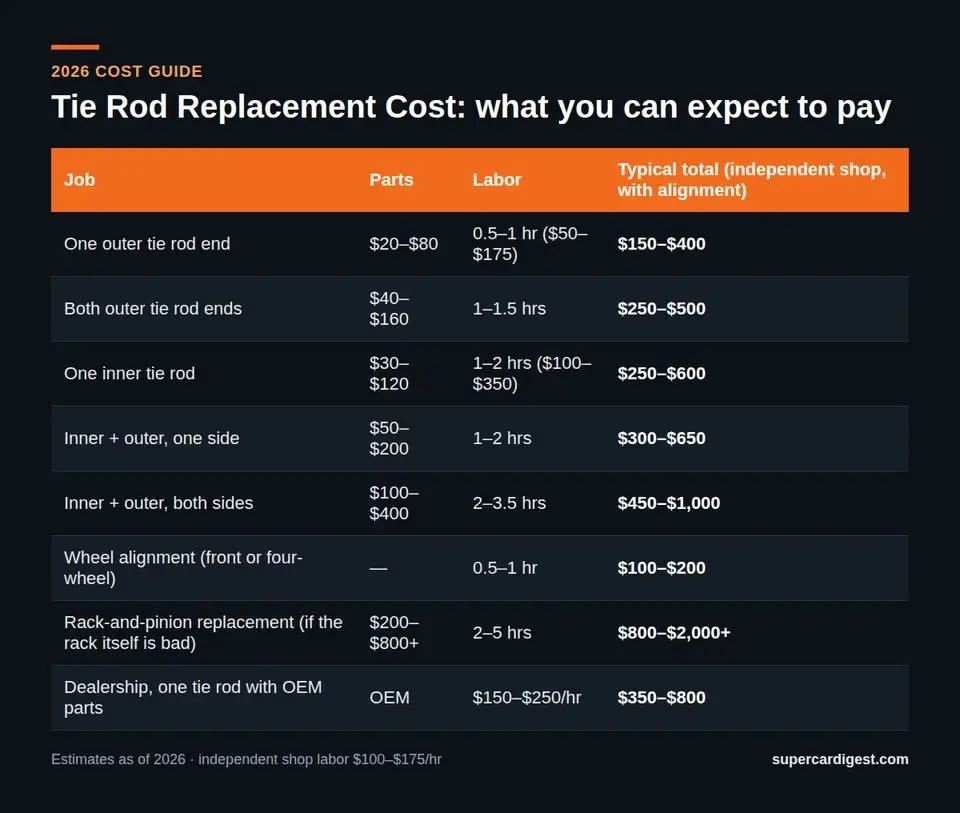
| Job | Parts | Labor | Typical total (independent shop, with alignment) |
|---|---|---|---|
| One outer tie rod end | $20–$80 | 0.5–1 hr ($50–$175) | $150–$400 |
| Both outer tie rod ends | $40–$160 | 1–1.5 hrs | $250–$500 |
| One inner tie rod | $30–$120 | 1–2 hrs ($100–$350) | $250–$600 |
| Inner + outer, one side | $50–$200 | 1–2 hrs | $300–$650 |
| Inner + outer, both sides | $100–$400 | 2–3.5 hrs | $450–$1,000 |
| Wheel alignment (front or four-wheel) | — | 0.5–1 hr | $100–$200 |
| Rack-and-pinion replacement (if the rack itself is bad) | $200–$800+ | 2–5 hrs | $800–$2,000+ |
| Dealership, one tie rod with OEM parts | OEM | $150–$250/hr | $350–$800 |
What a tie rod does: inner vs. outer
Tie rods connect your steering rack to the front wheels. When you turn the steering wheel, the rack slides left or right and the tie rods push or pull each wheel’s steering knuckle. Most cars have one assembly on each side, made of two parts:
- Inner tie rod — screws into the end of the steering rack and sits under a rubber bellows boot. It has a ball-and-socket joint that lets the rod move with the suspension.
- Outer tie rod end — threads onto the inner rod and bolts to the steering knuckle with a tapered stud. This is the part you can see behind the wheel, and the one that wears out most often.
The threaded joint between the two is also how a shop sets your toe alignment. That is why any tie rod replacement changes the alignment, even if the new part is the exact same length.
Some pickups and older SUVs with solid front axles or recirculating-ball steering use a longer tie rod and drag link setup instead. Those parts cost more and take longer, so expect the higher end of the ranges above.
Signs of a bad tie rod
- Loose or vague steering — the wheel has play before the car starts to turn.
- Shimmy or vibration in the steering wheel that gets worse with speed or over bumps.
- Uneven tire wear, especially wear on the inner or outer edge of one or both front tires.
- Clunk or knock from the front when turning at low speed, going over bumps, or rocking the wheel in a parking lot.
- Car wanders or pulls and needs constant small corrections on the highway.
- Torn inner tie rod boot or grease leaking from the outer end’s rubber seal.
- Failed alignment — the shop can’t bring the toe into spec, or it won’t stay there.
A quick check: with the front wheel off the ground, grab the tire at 3 and 9 o’clock and push and pull. Side-to-side play that stops when someone holds the tie rod points to a worn tie rod. Play at 12 and 6 o’clock is more likely a ball joint or wheel bearing.
Is it safe to drive with a bad tie rod?
Not for long. A slightly loose tie rod gives you sloppy steering and chews up tires. A badly worn one can pull apart, and if the outer end separates from the knuckle, that wheel is no longer connected to the steering wheel. At speed, that can send the car sharply to one side.
If you notice mild play or new uneven tire wear, get it inspected within a week or two and keep your speed moderate. If you hear a loud clunk when turning, feel the steering wheel jerk, or the car suddenly wanders, stop driving it and have it towed or driven only a short distance at low speed to a shop.
Don’t skip the alignment
Replacing a tie rod without an alignment is the most common way people turn a $200 repair into a $900 one. Even a small toe error scrubs the tires sideways every mile. A shop that offers to “eyeball it” or count threads is giving you a temporary setting at best. Get a proper alignment the same day or the next.
What drives the price up or down
1. Inner or outer
Outer ends are quick: remove the cotter pin and nut, pop the tapered stud out of the knuckle, and thread the new end on. Inner tie rods take longer because the boot must come off and the rod has to be unscrewed from the rack, often with a special tool. On some cars the inner rod is staked or pinned to the rack, which adds time.
2. Rust
In snowy states, the outer end can be seized to the inner rod. Freeing it may take heat, extra time, or replacing both parts even if only one was worn. Expect an extra 0.5–1 hour on rusty vehicles.
3. One side or both
You do not have to replace tie rods in pairs the way you do brakes. But on a high-mileage car, if one side is worn the other is often close. Doing both at once shares a single alignment charge, which is where most of the savings come from.
4. Part quality
Economy tie rod ends can wear out in a year or two. Mid-grade aftermarket or OEM parts cost $20–$50 more per side and usually last much longer. Ask which brand the shop is using.
5. Bundled front-end work
Shops often find worn tie rods during a tire, brake or suspension inspection. Bundling them with control arms, ball joints or struts can save on labor and share one alignment. Our car suspension repair cost guide covers the bigger picture.
Dealer vs. independent shop vs. DIY
| Option | One outer tie rod + alignment | Inner + outer, both sides + alignment | Notes |
|---|---|---|---|
| Dealership | $350–$800 | $800–$1,500 | OEM parts, higher labor rate |
| Independent shop | $150–$400 | $450–$1,000 | Best value for most owners |
| DIY + shop alignment | $120–$280 | $200–$600 | Needs a tie rod separator and inner tie rod tool |
An outer tie rod end is one of the more approachable DIY suspension jobs. The trick is to count the turns or measure the length of the old part before removing it, then set the new one to match. That gets you close enough to drive straight to an alignment shop. Inner tie rods need a rental inner tie rod tool from a parts store and more patience. Either way, the professional alignment is still required.
Super Car Digest · $14
The Used Car Buying Playbook
Big repair bill on an older car? Before you pay for it, run the numbers on replacing the car — and if you do switch, don’t overpay for the next one. Budget worksheet, 15-minute VIN screen, test-drive routine, word-for-word negotiation scripts and a 10-point contract check.
How to pay less without cutting corners
- Ask which part is worn. Have the shop show you the play. Outer ends fail far more often than inner rods.
- Get an independent quote. Tie rods are routine work that doesn’t need a dealer.
- Do both sides together on a high-mileage car to pay for one alignment instead of two.
- Use mid-grade or OEM parts, not the cheapest line on the shelf.
- Check your coverage. Tie rods are sometimes covered by powertrain-plus or exclusionary plans; see are extended car warranties worth it? before you buy one for repairs like this.
- Fix it early. Waiting usually costs you a pair of front tires ($200–$600) on top of the repair.
Shopping for a used car?
Front-end play, uneven front tire wear and a steering wheel that sits off-center are easy to spot on a test drive. They don’t always mean a bad car, but they are good bargaining points. Our used car inspection guide shows what to check.
When to walk away instead
Tie rods alone are almost never a reason to give up on a car. The math changes when they are part of a long list: tie rods, control arms, a leaking steering rack, worn CV axles and an oil leak all at once. Add up everything the shop found and compare it with the car’s value. If the total is more than about half of what the car is worth, read our guide on whether it’s worth fixing an old car before you sign off.
Frequently asked questions
How much does it cost to replace a tie rod?
About $150–$400 for one outer tie rod end and $250–$600 for one inner tie rod at an independent shop, including the alignment. Both sides, inner and outer, run about $450–$1,000. Estimates as of 2026.
Do I need an alignment after replacing tie rods?
Yes. The tie rod sets the front toe angle, so any replacement changes it. Without an alignment, the car may pull and the front tires can wear out quickly.
Should tie rods be replaced in pairs?
It isn’t required, but on an older car it often makes sense. Both sides have the same mileage, and doing them together means paying for one alignment instead of two.
How long does it take to replace a tie rod?
An outer end usually takes 30–60 minutes. An inner tie rod takes 1–2 hours. Add 30–60 minutes for the alignment.
How long do tie rods last?
Many last 70,000–150,000 miles. Rough roads, potholes, curb strikes, torn boots and larger aftermarket wheels can shorten that a lot.
Can a bad tie rod cause a vibration?
Yes. A loose tie rod can cause a shimmy in the steering wheel, especially over bumps or at highway speed. Out-of-balance tires and warped rotors cause similar feelings, so have the front end checked before buying parts.
Sources and methodology
Price ranges combine 2026 estimates from the RepairPal estimator for inner and outer tie rods and wheel alignments, published labor-time guides, current retail parts pricing and labor at typical 2026 shop rates ($100–$175/hr independent, $150–$250/hr dealer; AAA has reported national averages around $140/hr). These are estimates; your quote will vary by vehicle, region and condition.