Key takeaways
- A check engine light on after a fill-up is often a loose gas cap. The car’s EVAP system sees a vapor leak and stores a code such as P0455, P0457 or P0456.
- Tighten the cap until it clicks. The light usually goes off by itself after several drive cycles, often within a few days of normal driving.
- A new gas cap costs about $15–$60. Replace it if the seal is cracked, flattened or the cap does not click.
- If the light returns after a new cap, the leak is elsewhere. EVAP repairs often run $150–$800 at an independent shop.
- A gas cap fault is not urgent, but a flashing light or poor running is a different problem.
A check engine light on because of a loose gas cap is one of the most common and cheapest warning lights you will see. Your car’s evaporative emissions (EVAP) system seals the fuel tank and tests it for leaks. If the cap is loose, missing or its rubber seal is worn, the test fails and the computer stores a leak code. The fix is simple: tighten the cap until it clicks, or replace it for $15–$60, then drive normally. The light usually turns off by itself after the system passes its self-test over several drives. If it does not, there is likely another leak, such as a cracked hose or a stuck purge valve. This guide covers the codes, the timing, the real causes when it is not the cap, and what each fix costs in 2026.
📩 Important: after you sign up, open the email from Super Car Digest and tap Confirm. Your checklist opens right away. Not there? Check Spam or Promotions.
Gas cap and EVAP codes: what they mean and what they cost
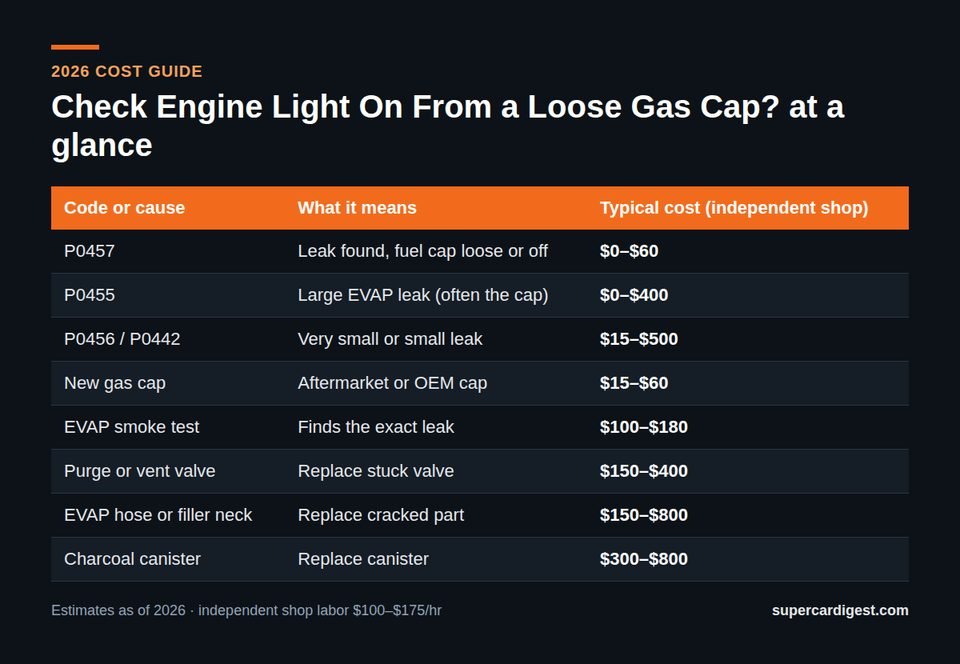
| Code or cause | What it means | Typical cost (independent shop) |
|---|---|---|
| P0457 | Leak found, fuel cap loose or off | $0–$60 |
| P0455 | Large EVAP leak (often the cap) | $0–$400 |
| P0456 / P0442 | Very small or small leak | $15–$500 |
| New gas cap | Aftermarket or OEM cap | $15–$60 |
| EVAP smoke test | Finds the exact leak | $100–$180 |
| Purge or vent valve | Replace stuck valve | $150–$400 |
| EVAP hose or filler neck | Replace cracked part | $150–$800 |
| Charcoal canister | Replace canister | $300–$800 |
Code wording varies a little by manufacturer, but the pattern is the same: the EVAP system holds a slight vacuum or pressure and watches whether it leaks away. A larger leak is easier to detect and is the type most often caused by a cap that is loose or not on at all.
Why a loose gas cap turns on the check engine light
Gasoline gives off vapors, and those vapors are a pollutant. The EVAP system traps them in a charcoal canister and later draws them into the engine to be burned. To prove the system is sealed, the engine computer periodically closes a vent valve and checks whether the tank holds vacuum or pressure. A loose cap lets air in or out, the test fails, and the light comes on.
The light often comes on a day or two after a fill-up, not right away. That is because the leak test only runs under certain conditions, such as after the car has sat for a while, at certain fuel levels and outside temperatures. Some cars display a separate “check fuel cap” message before the check engine light comes on, which gives you a chance to tighten it first.
How to tighten it properly
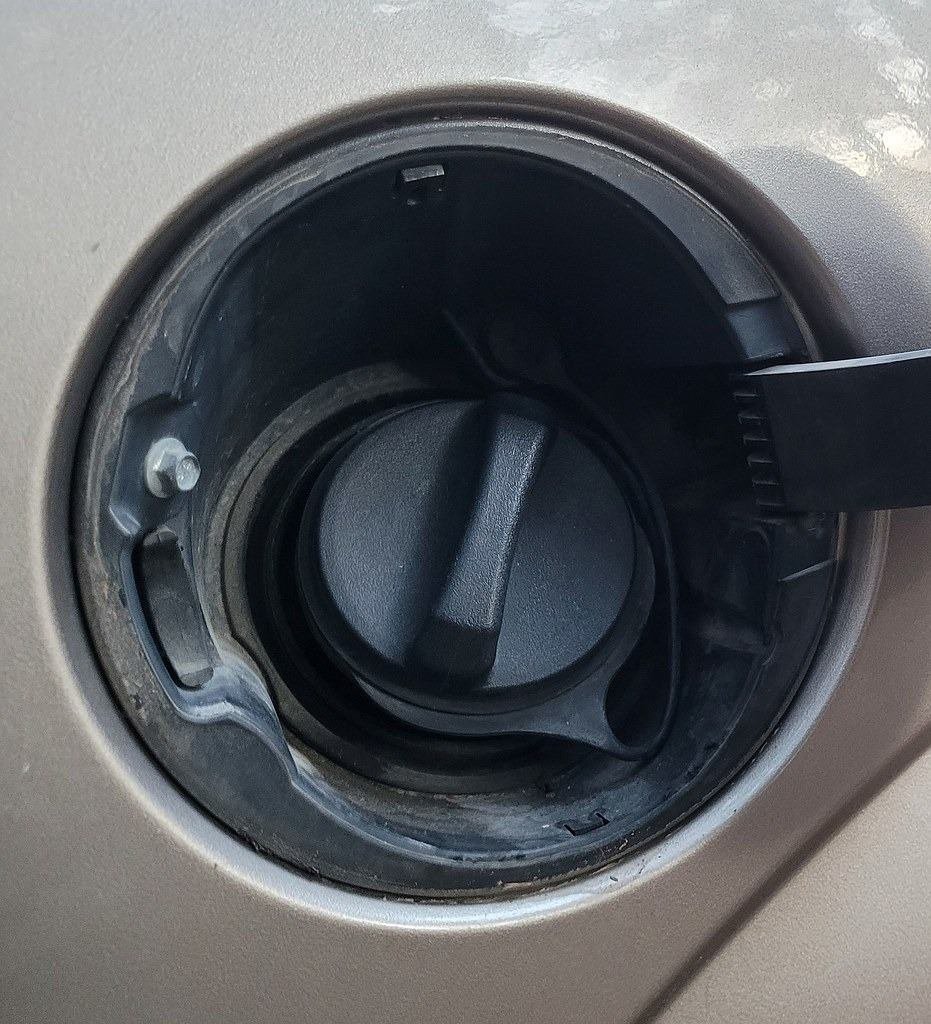
Turn the cap until it clicks at least once; many caps are designed to click several times. Check that nothing is caught in the threads and that the rubber O-ring is seated and not twisted. On capless fuel fillers, make sure the spring flap closes fully and is not held open by dirt.
How long until the check engine light goes off?
After you tighten or replace the cap, the light does not turn off instantly. The computer has to run the EVAP test again and pass it, usually on more than one trip. On many cars that happens within a few days of normal driving, but EVAP tests are among the pickiest monitors. They may wait for a cold start after the car has been parked for several hours and for the fuel level to be between roughly a quarter and three-quarters full.
If you do not want to wait, an OBD2 scanner can clear the code in minutes. Just remember that clearing also resets your emissions readiness monitors, so do not do it right before an inspection. Our guide on how to reset a check engine light explains the trade-offs.
If a week or so of regular driving passes and the light is still on, or it comes back after being cleared, treat it as a leak somewhere else.
When it’s not the gas cap
A new cap fixes many EVAP codes, but not all. Other common sources of leaks include:
- Purge valve (solenoid). It controls when fuel vapors flow to the engine. A valve stuck open can also cause rough idle right after refueling or hard starting.
- Vent valve. Usually near the charcoal canister, often under the car near the tank, where it is exposed to dirt and water.
- Cracked hoses and lines. Rubber and plastic EVAP lines age and crack, especially in hot climates.
- Filler neck. Rust on the metal filler neck, common in snowy states, can prevent any cap from sealing.
- Charcoal canister. Can crack or become saturated, sometimes from habitually topping off the tank after the pump clicks off.
- Leak detection pump or pressure sensor. Some vehicles use a pump to test the system; if it fails, it can set codes on its own.
The most reliable way to find these leaks is a smoke test. A shop pumps harmless visible vapor into the EVAP system and watches where it escapes. It usually costs $100–$180 and saves money compared with replacing parts by guesswork.
Is it safe to drive with an EVAP or gas cap code?
Usually yes. A small EVAP leak does not affect how the engine runs, and the car will not break down because of it. The main problems are a small amount of fuel vapor escaping, a possible faint fuel smell, and a failed emissions test, since most OBD2 inspection programs fail a car with the check engine light on.
There is a real downside to ignoring it, though. While the light is on for a minor EVAP code, it cannot warn you about a new, more serious problem. If a misfire or oxygen sensor fault appears, you may not notice because the light was already on.
These are not gas cap problems
If the check engine light is flashing, the engine is shaking or losing power, or you smell strong raw fuel near the car, do not assume it is the cap. A strong fuel smell can mean a leaking fuel line or injector, which is a fire risk. Park away from ignition sources and have it inspected. A flashing light is covered in our guide on a flashing check engine light.
Gas cap replacement cost and buying tips
A replacement gas cap costs about $15–$30 for an aftermarket model and $25–$60 for an OEM cap from a dealer. Installation takes seconds and requires no tools. A few tips:
- Match your vehicle. Caps differ in thread type and pressure rating. Use the parts-store lookup or your VIN.
- Prefer OEM or a well-known brand if a cheap cap did not fix the code. Some low-cost caps do not seal well on every vehicle.
- Inspect the old seal. A cracked, hardened or flattened O-ring is a clear sign the cap was the problem.
- Keep the tether intact so the cap does not get left at the pump.
- Do not top off. Stop when the pump clicks off. Overfilling can push liquid fuel into the canister and damage it over time.
Other causes of a steady check engine light
If your scan shows codes that are not EVAP-related, the gas cap is not the cause. Common steady-light culprits include a worn oxygen sensor (see our O2 sensor replacement cost guide), a catalytic converter efficiency code, a dirty mass airflow sensor, or a stuck PCV valve causing a lean condition. Read the code first, then fix the cause, rather than guessing.
If your car is older and the check engine light is one of several issues, add up the repairs and compare them with the car’s value before spending. Our guide on whether it’s worth fixing an old car walks through that decision.
Useful on Amazon for this job
As an Amazon Associate we earn from qualifying purchases. Always confirm fit for your exact vehicle or ask your dentist.
Super Car Digest · $14
The Used Car Buying Playbook
Big repair bill on an older car? Before you pay for it, run the numbers on replacing the car — and if you do switch, don’t overpay for the next one. Budget worksheet, 15-minute VIN screen, test-drive routine, word-for-word negotiation scripts and a 10-point contract check.
Frequently asked questions
Can a loose gas cap cause the check engine light to come on?
Yes. It is one of the most common causes. The EVAP system detects the vapor leak and stores a code, often P0455 or P0457.
How many miles until the check engine light turns off after tightening the gas cap?
It depends on drive cycles rather than miles. Many cars clear it within a few days of normal driving; some take a week or more because the EVAP test runs only under specific conditions.
Will a new gas cap fix code P0455?
Often, but not always. If the light returns after a new cap, a smoke test can find leaks in the hoses, valves, filler neck or canister.
How much does a gas cap cost?
About $15–$30 aftermarket and $25–$60 OEM. Estimates as of 2026.
Will I fail an emissions test with a gas cap code?
In most OBD2 testing programs, yes, if the check engine light is on. Clearing the code right before the test can also cause a rejection because readiness monitors will be incomplete.
Sources and methodology
Code definitions follow standard OBD2 EVAP diagnostic trouble codes; system descriptions reflect general US EPA guidance on evaporative emissions controls. Price ranges combine 2026 estimates from the RepairPal estimator, published labor-time guides, current retail pricing for aftermarket and OEM caps and EVAP parts, and labor at typical 2026 shop rates ($100–$175/hr independent, $150–$250/hr dealer; AAA has reported national averages around $140/hr). These are estimates; your quote will vary by vehicle, region and condition.