Key takeaways
- An oil pump replacement typically costs $400–$1,500 at an independent shop when the pump sits in the oil pan, and $900–$2,800 when it is driven by the timing chain or built into the timing cover.
- The pump itself is usually $50–$350. Most of the bill is labor, often 3–10 hours or more.
- A low oil pressure light is the main warning sign, but a bad pump is far less common than low oil, a clogged pickup screen or a faulty pressure sensor.
- Driving with real low oil pressure can destroy the engine in minutes, so stop and diagnose first.
- Estimates as of 2026; your price depends on engine design, parts brand and local labor rates ($100–$175/hr independent, $150–$250/hr dealer).
The oil pump replacement cost for most cars and trucks in 2026 is about $400 to $1,500 at an independent shop when the pump sits in the oil pan, about $900 to $2,800 on engines where the pump hides behind the timing cover, and $1,500 to $3,500 or more at a dealer. Parts usually run $50–$350 for the pump plus gaskets, oil and a filter, while labor makes up the rest, often $300–$1,500 or more. This guide explains what the pump does, how to tell a bad pump from cheaper problems, whether you can drive, and when the engine is worth saving.
📩 Important: after you sign up, open the email from Super Car Digest and tap Confirm. Your checklist opens right away. Not there? Check Spam or Promotions.
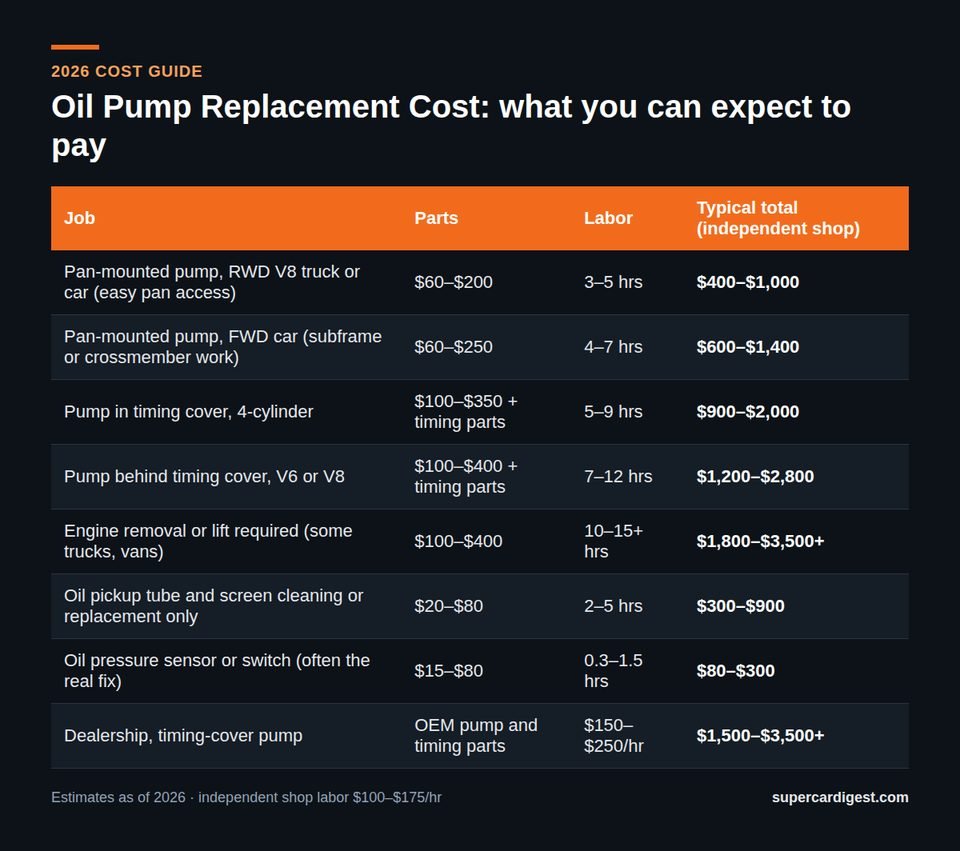
Oil pump replacement cost in 2026 at a glance
| Job | Parts | Labor | Typical total (independent shop) |
|---|---|---|---|
| Pan-mounted pump, RWD V8 truck or car (easy pan access) | $60–$200 | 3–5 hrs | $400–$1,000 |
| Pan-mounted pump, FWD car (subframe or crossmember work) | $60–$250 | 4–7 hrs | $600–$1,400 |
| Pump in timing cover, 4-cylinder | $100–$350 + timing parts | 5–9 hrs | $900–$2,000 |
| Pump behind timing cover, V6 or V8 | $100–$400 + timing parts | 7–12 hrs | $1,200–$2,800 |
| Engine removal or lift required (some trucks, vans) | $100–$400 | 10–15+ hrs | $1,800–$3,500+ |
| Oil pickup tube and screen cleaning or replacement only | $20–$80 | 2–5 hrs | $300–$900 |
| Oil pressure sensor or switch (often the real fix) | $15–$80 | 0.3–1.5 hrs | $80–$300 |
| Dealership, timing-cover pump | OEM pump and timing parts | $150–$250/hr | $1,500–$3,500+ |
Every quote should include fresh oil, a new filter and new gaskets or sealant for the pan and any covers removed. On timing-cover pumps, many shops also recommend a timing chain, guides and tensioner while they are in there, which raises the parts bill but avoids paying the same labor twice later.
What the oil pump does
The oil pump pulls oil from the oil pan through a pickup tube and screen and pushes it under pressure through the filter and into passages that feed the crankshaft bearings, camshafts, lifters, timing chain and, on many engines, the turbocharger. Without that pressure, metal parts rub against each other and the engine can fail quickly.
Most pumps are mechanical and driven by the crankshaft, either directly at the front of the engine or by a chain or gear. Some newer engines use a variable-displacement pump, which costs more and may be controlled by a solenoid. The location is what makes this repair expensive: the pump is typically inside the oil pan or behind the timing cover, both of which take hours to reach.
Symptoms of a bad oil pump
- Low oil pressure warning light or a gauge reading near zero at idle or while driving.
- Valve train noise, such as ticking or tapping from the top of the engine, because the lifters are not getting enough oil.
- Knocking from the bottom of the engine, a sign bearings are already being damaged.
- Rising engine temperature, since oil also helps carry heat away.
- Whining from the front or bottom of the engine on some designs, from a worn pump or drive.
Before anyone replaces the pump, the shop should rule out the cheaper causes. The most common are low oil level, oil that is very old or the wrong viscosity, a failed oil pressure sensor, and a clogged pickup screen full of sludge. Leaks are a frequent reason oil runs low; our car oil leak repair cost guide covers the usual sources.
The proper test is a mechanical oil pressure gauge screwed into the sensor port. It shows the real pressure and costs far less than guessing. Worn engine bearings can also cause low pressure even with a healthy pump, which matters a lot for the repair decision.
Check the cheap things first
Check the dipstick, then ask for a mechanical pressure test. A $100–$300 sensor replacement or an oil change fixes many “oil pump” warnings. Only approve pump replacement after real pressure is confirmed low.
Is it safe to drive with a bad oil pump?
No. If the oil pressure light comes on while driving, pull over safely and shut the engine off as soon as you can. Check the oil level once it has sat for a few minutes. If it is low, adding oil may solve the problem. If the level is fine and the light stays on, or you hear knocking, do not keep driving.
Without enough oil pressure, the crankshaft and connecting rod bearings can wear through quickly. Once a bearing spins or the crankshaft is scored, a new pump will not save the engine, and you are looking at a rebuild or replacement engine. A tow is almost always cheaper than that.
Stop driving if you notice these
A red oil pressure light or a gauge at zero, deep knocking from the bottom of the engine, or loud ticking that started suddenly. Shut off the engine and arrange a tow.
What drives the price up or down
1. Pump location
This sets most of the price. Pumps inside the oil pan on rear-wheel-drive trucks can be relatively quick. On many front-wheel-drive cars, the subframe or crossmember is in the way. Pumps behind the timing cover require removing accessories, the crank pulley and the timing chain, which can take a full day or more.
2. Timing components
If the timing chain has to come off, replacing the chain, guides and tensioner adds $150–$500 in parts but very little extra labor. On high-mileage engines, it is usually a smart add.
3. Engine condition
If the engine ran low on oil pressure for a while, the shop may find damaged bearings or sludge. Cleaning sludge out of the pan and passages adds time, and bearing damage can change the repair entirely.
4. Related seals
With the pan or timing cover off, it costs little extra to replace the front crank seal or the pan gasket. The rear main seal is a separate, bigger job on most engines; see our rear main seal replacement cost guide if that is also leaking.
5. Parts choice
Name-brand aftermarket pumps are often fine for common engines. For variable-displacement pumps, high-performance or European engines, OEM parts are usually the safer choice.
Dealer vs. independent shop vs. DIY
| Option | Typical cost | Pros | Cons |
|---|---|---|---|
| Dealership | $1,500–$3,500+ | OEM parts, model-specific procedures | Highest labor rate |
| Independent shop | $400–$2,500 | Fair rates, can source quality aftermarket parts | Pick one experienced with your engine |
| Chain shop | $600–$2,500 | Convenient | Many chains avoid internal engine work |
| DIY | $50–$600 in parts | Lowest cost on simple pan-mounted pumps | Engine support, timing alignment and correct torque are essential; mistakes can ruin the engine |
An oil pump is not a beginner job. On some rear-wheel-drive V8s, an experienced home mechanic can drop the pan and swap the pump in a weekend. On timing-cover pumps, a timing mistake can bend valves. If you are not confident, leave it to a shop.
How to pay less without cutting corners
- Confirm low pressure with a mechanical gauge before approving the pump.
- Rule out the sensor and oil level first. These are the cheapest fixes.
- Get two quotes from independent shops that do engine work regularly.
- Bundle overlapping parts such as the timing chain set or pan gasket when labor is shared.
- Keep up with oil changes. Clean oil helps prevent sludge from clogging the pickup screen.
- Check your coverage. The oil pump is usually covered under powertrain warranties. See are extended car warranties worth it?
When the engine is worth saving, and when to walk away
An oil pump job makes the most sense when the problem was caught early: the light came on, the driver shut the engine off, and there is no knocking. In that case, a $600–$2,000 repair can restore a healthy engine for many more miles.
The picture changes if the engine has been knocking, has high mileage with worn bearings, or needs other major work. A shop may then recommend a used or rebuilt engine instead, which often costs $3,000–$7,000 installed. If that number is close to what the car is worth, replacing the car may be the better choice. Our guide on whether it’s worth fixing an old car explains the 50% rule, and the repair or replace calculator lets you compare the options with your own numbers.
Useful on Amazon for this job
As an Amazon Associate we earn from qualifying purchases. Always confirm fit for your exact vehicle or ask your dentist.
Super Car Digest · $14
The Used Car Buying Playbook
Big repair bill on an older car? Before you pay for it, run the numbers on replacing the car — and if you do switch, don’t overpay for the next one. Budget worksheet, 15-minute VIN screen, test-drive routine, word-for-word negotiation scripts and a 10-point contract check.
Frequently asked questions
How much does it cost to replace an oil pump?
About $400–$1,500 at an independent shop for pan-mounted pumps, and $900–$2,800 for pumps behind the timing cover. Dealers often charge $1,500–$3,500 or more. Estimates as of 2026.
Why is oil pump replacement so expensive?
The part is often inexpensive, but it is buried inside the oil pan or behind the timing cover. Reaching it can take 3 to 12 hours of labor or more.
How do I know if it is the oil pump or the sensor?
A shop can install a mechanical oil pressure gauge. If real pressure is normal, the sensor or wiring is the problem. If it is low and the oil level is correct, the pump, pickup screen or worn bearings are likely.
Can I drive with the oil pressure light on?
No. Pull over, shut the engine off and check the oil level. Driving with genuinely low pressure can wreck the engine quickly.
How long does an oil pump last?
Many oil pumps last the life of the engine. Failures are often linked to sludge, debris or long oil change intervals rather than normal wear.
Should I replace the timing chain with the oil pump?
If the chain has to come off to reach the pump and the engine has high mileage, replacing the chain, guides and tensioner at the same time is usually good value.
Sources and methodology
Price ranges combine 2026 estimates from the RepairPal estimator for oil pump and oil pressure sensor replacement, published labor-time guides, current retail pricing for aftermarket and OEM pumps, and labor at typical 2026 shop rates ($100–$175/hr independent, $150–$250/hr dealer; AAA has reported national averages around $140/hr). These are estimates; your quote will vary by vehicle, region and condition.