Key takeaways
- A rear main seal replacement typically costs $700–$2,000 at an independent shop. The seal itself is only $15–$80; labor is usually 5–12 hours.
- It is labor-heavy because the transmission (and on manuals, the clutch) has to come off to reach the seal.
- RWD trucks and cars are usually cheapest; FWD and AWD vehicles often cost more because of axles, subframes and transfer cases.
- On a manual, replacing the clutch during the same job adds only $250–$700 in parts and little extra labor.
- Estimates as of 2026; your price depends on the vehicle, drivetrain and local labor rates ($100–$175/hr independent, $150–$250/hr dealer).
The rear main seal replacement cost for most cars and trucks in 2026 is about $700 to $2,000 at an independent shop: only $15–$80 for the seal and gasket parts, but $600–$1,900 in labor because the transmission has to be removed to reach it. Dealers commonly charge $1,500–$3,500, and some AWD and luxury vehicles go higher. This guide explains why the labor is so high, how drivetrain layout changes the price, the leak signs, an honest look at stop-leak additives, when it makes sense to simply top off the oil, and why manual owners should consider a clutch at the same time.
📩 Important: after you sign up, open the email from Super Car Digest and tap Confirm. Your checklist opens right away. Not there? Check Spam or Promotions.
Rear main seal replacement cost in 2026 at a glance
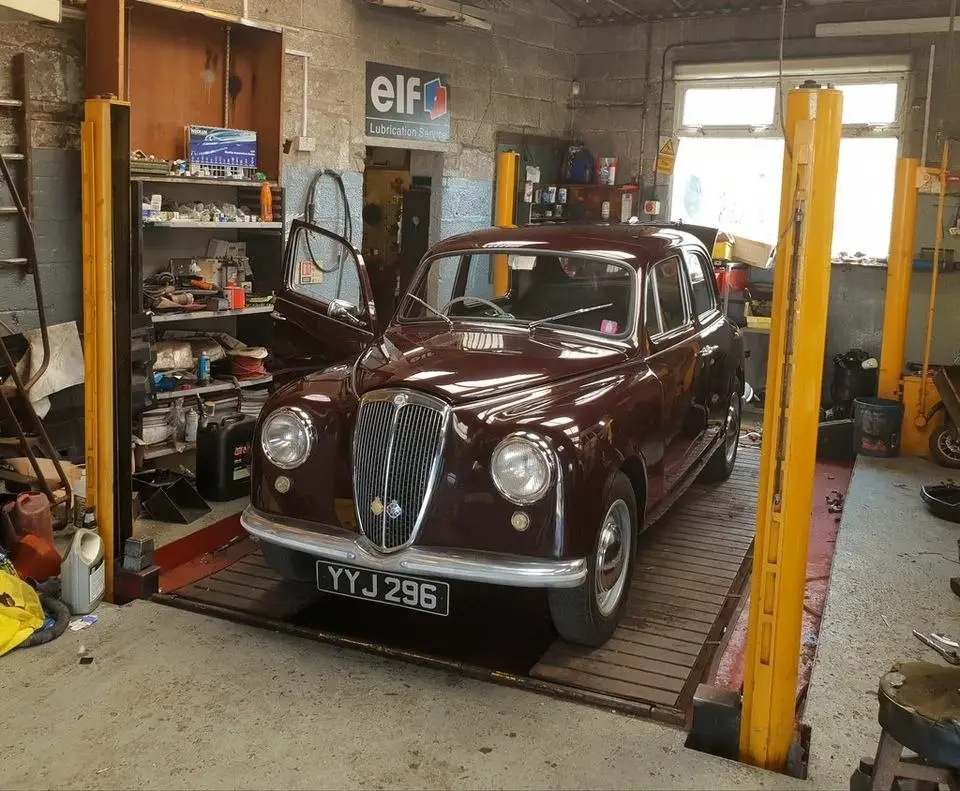
| Vehicle / job | Parts | Labor | Typical total (independent shop) |
|---|---|---|---|
| RWD car or pickup, automatic | $15–$80 seal, plus fluids | 4–7 hrs ($400–$1,225) | $700–$1,400 |
| FWD car or crossover (transverse engine) | $15–$80 seal, plus fluids | 5–9 hrs ($500–$1,575) | $800–$1,800 |
| AWD or 4×4 (transfer case removal) | $20–$100 seal, plus fluids | 6–12 hrs ($600–$2,100) | $1,000–$2,200 |
| Manual transmission, seal only | $15–$80 | 4–8 hrs | $700–$1,600 |
| Manual, seal plus clutch kit | $250–$700 clutch kit | 4.5–8.5 hrs | $1,000–$2,200 |
| Add-on: flywheel resurface or flexplate | $50–$400 | 0–0.5 hr | $60–$450 |
| Add-on: oil pan gasket during same job | $20–$80 | 0.5–2 hrs | $100–$350 |
| Dealership, any layout | OEM ($30–$150) | $150–$250/hr | $1,500–$3,500+ |
Labor times vary widely by model, so ask the shop for the book labor time on your exact vehicle; it explains most of the quote.
What the rear main seal is and why it is expensive
The rear main seal is a round rubber or PTFE seal at the back of the engine where the crankshaft exits the block. It keeps engine oil inside while the crankshaft spins thousands of times a minute. Over many years and miles, the seal hardens, shrinks or wears a groove, and oil starts to seep out.
The problem is location. The seal sits between the engine and the transmission, behind the flywheel or flexplate. To reach it, a mechanic usually has to disconnect the driveshaft or axles, unbolt and lower the transmission, remove the flywheel or flexplate (and the clutch on a manual), and then replace the seal. The part is cheap; the hours are not.
RWD vehicles with a longitudinal engine are often the simplest, because the transmission slides straight back after the driveshaft comes out. FWD cars with a transverse engine often require removing both axles, mounts and sometimes the subframe. AWD and 4×4 models add a transfer case and extra driveshafts, which pushes labor to the high end.
Signs of a leaking rear main seal
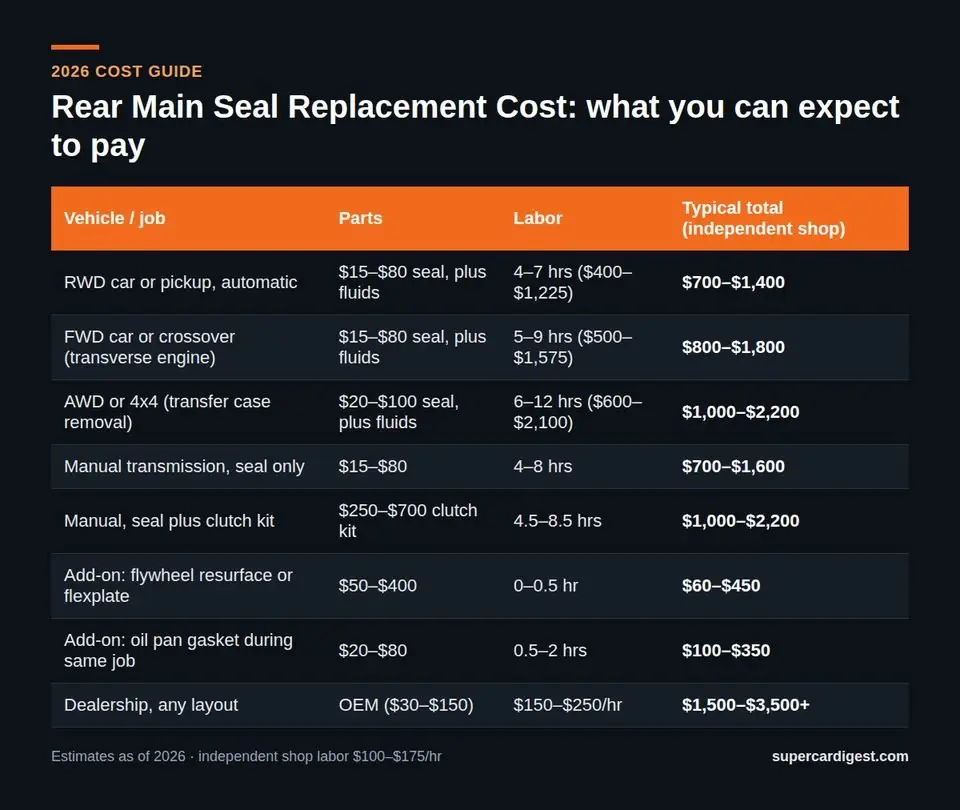
- Oil dripping from where the engine meets the transmission, often from a small hole at the bottom of the bell housing.
- Oil spots under the middle of the car, not at the front of the engine.
- Losing oil between changes without blue smoke from the exhaust.
- An oily film on the bottom of the transmission bell housing or oil pan seam.
- Clutch slipping or chatter on a manual, if oil has reached the clutch disc.
Many leaks blamed on the rear main seal turn out to be something cheaper. Oil from a leaking valve cover gasket, oil pan gasket, oil filter housing or oil pressure sender can run down the back of the engine and drip from the same spot. A good shop will clean the area, add a UV dye to the oil, and check again after a short drive to confirm the source. Our car oil leak repair cost guide covers those other leaks.
Confirm the leak before paying for the job
A dye test usually costs $50–$150 and can save you from a $1,500 repair that does not fix the leak. Ask the shop to show you where the oil is coming from on a lift before you approve the transmission removal.
Is it safe to drive with a rear main seal leak?
Usually, yes, if the leak is slow and you keep the oil level full. Many older vehicles seep a few drops from the rear main seal for years. The real danger is letting the oil get low, which can damage the engine far more expensively than any seal job.
A faster leak is a different story. Oil on the clutch can cause slipping, oil dripping onto hot exhaust parts can smoke or, in rare cases, catch fire.
Stop driving if you notice these
An oil pressure warning light, oil level dropping a quart or more every few hundred miles, smoke from under the car, or a steady drip while the engine runs. Check the dipstick, add oil, and get the car inspected before driving further.
When to just top off the oil
On an older car with a slow seep, monitoring the leak can be the smartest financial choice. If you lose less than about a quart every 1,000–2,000 miles, oil is not dripping on the exhaust, the clutch is fine and the car is not worth much more than the repair, many mechanics will tell you to check the dipstick every couple of fill-ups and keep a quart in the trunk. A quart of oil costs far less than a transmission removal.
Switching to a high-mileage oil at your next oil change is a low-cost step. They will not fix a damaged seal, but some drivers see a slow seep ease.
Stop-leak additives are a more mixed bag. They work by making rubber seals swell slightly. That can slow a minor leak from a hardened seal, sometimes for a long time. They cannot fix a seal that is torn, installed crooked, or leaking because of a worn crankshaft surface, and results vary by product and engine. Use them as a short-term measure on a car you are not planning to keep long, follow the label, and do not count on them to fix the problem.
What drives the price up or down
1. Drivetrain layout
This is the main factor. A RWD pickup might be a five-hour job, while a FWD crossover with a tight engine bay or an AWD SUV can take ten hours or more. Removing an engine or transmission may also mean replacing worn motor or transmission mounts, which is cheaper to do while everything is out.
2. Manual vs. automatic
On a manual, the clutch is already off to reach the seal. If the clutch has a lot of miles or any oil on it, replacing it now costs only the parts and a little extra time. Putting a worn clutch back in can mean paying the same transmission labor again in a year or two.
Dealer vs. independent shop vs. DIY
| Option | Typical cost | Pros | Cons |
|---|---|---|---|
| Dealership | $1,500–$3,500+ | OEM seal, model-specific tools | Highest labor rate on a labor-heavy job |
| Independent shop | $700–$2,000 | Fair labor rate, good for transmission work | Quality depends on shop experience |
| Transmission specialist | $800–$2,000 | Removes transmissions daily | May be booked out |
| DIY | $15–$100 in parts | Huge labor savings | Needs a lift or tall stands, a transmission jack and seal installer; easy to install the seal crooked |
DIY is possible for an experienced home mechanic on some RWD trucks, but it is a big job. A seal installed slightly off-angle will leak again. For most owners, this is a job to hand to a shop.
How to pay less without cutting corners
- Confirm the source with a dye test before approving the job.
- Combine work. Do the clutch, mounts or oil pan gasket while the transmission is out.
- Use an independent or transmission shop instead of a dealer to save on hourly rate.
- Monitor a slow seep on an older car instead of rushing into a large repair.
- Check your coverage. Seals and gaskets are covered under some powertrain and extended plans. See are extended car warranties worth it?
When to walk away from the repair
A rear main seal is a good example of a repair that can cost more than an older car is worth. A $1,800 bill on a car worth $3,000 is hard to justify, especially if the leak is slow and topping off works. Add up every needed repair and compare it with the car’s value. Our guide on whether it’s worth fixing an old car explains the 50% rule, and the repair or replace calculator runs the numbers for you.
Super Car Digest · $14
The Used Car Buying Playbook
Big repair bill on an older car? Before you pay for it, run the numbers on replacing the car — and if you do switch, don’t overpay for the next one. Budget worksheet, 15-minute VIN screen, test-drive routine, word-for-word negotiation scripts and a 10-point contract check.
Frequently asked questions
How much does it cost to replace a rear main seal?
About $700–$2,000 at an independent shop and $1,500–$3,500 or more at a dealer. The seal costs $15–$80; nearly all of the bill is labor. Estimates as of 2026.
Why is a rear main seal replacement so expensive?
The transmission has to come off to reach the seal, and on FWD and AWD vehicles that can also mean removing axles, a transfer case or a subframe. That usually takes 5–12 hours of labor.
Does stop-leak work on a rear main seal?
Sometimes, for a minor seep from a hardened seal. It cannot fix a torn or misaligned seal. Treat it as a temporary measure, not a repair.
Can I just keep adding oil?
For a slow leak on an older car, often yes. Check the dipstick regularly, never let it run low, and make sure oil is not dripping on the exhaust or the clutch.
Should I replace the clutch with the rear main seal?
On a manual with high mileage or oil on the clutch, yes. The clutch is already out, so you pay mainly for parts instead of paying the same transmission labor twice later.
Sources and methodology
Price ranges combine 2026 estimates from the RepairPal estimator for rear main seal replacement, published labor-time guides, current retail pricing for seals, clutch kits and fluids, and labor at typical 2026 shop rates ($100–$175/hr independent, $150–$250/hr dealer; AAA has reported national averages around $140/hr). These are estimates; your quote will vary by vehicle, region and condition.