Key takeaways
- A power steering pump replacement typically costs $400–$900 at an independent shop. A remanufactured pump costs $80–$250; labor is usually 1–3 hours.
- Electro-hydraulic pumps (an electric motor driving a hydraulic pump) used on some cars cost more: $800–$2,000.
- A power steering fluid flush runs $100–$200 and is often done with a new pump to protect it from debris.
- Cars with electric power steering (EPS) have no pump at all, so if a shop quotes you a pump on an EPS car, ask questions.
- Estimates as of 2026; your price depends on the vehicle, part type and local labor rates ($100–$175/hr independent, $150–$250/hr dealer).
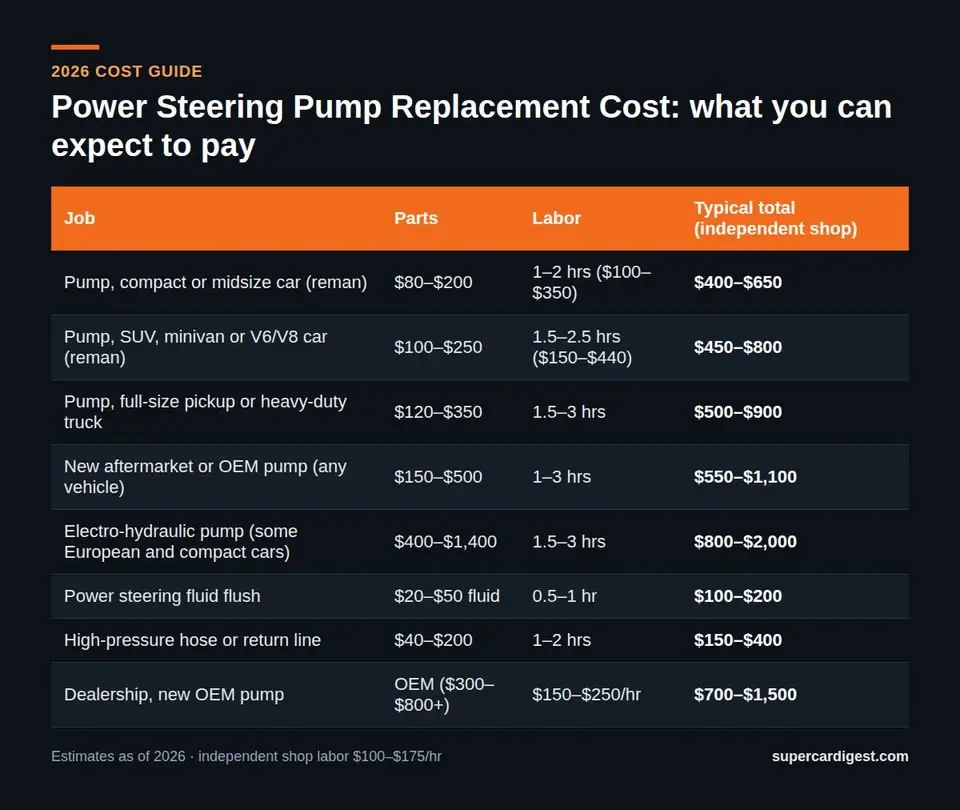
The power steering pump replacement cost for most cars and trucks in 2026 is about $400 to $900 at an independent shop: roughly $80–$250 for a remanufactured pump, $150–$500 for a new one, and $100–$500 in labor, plus fluid. Dealers using new OEM pumps commonly charge $700–$1,500. Some European and compact cars use an electro-hydraulic pump that can push the bill to $800–$2,000. This guide covers pump prices, the whining and stiff-steering symptoms, whether you need a fluid flush, why EPS cars do not have a pump, and how to avoid overpaying.
📩 Important: after you sign up, open the email from Super Car Digest and tap Confirm. Your checklist opens right away. Not there? Check Spam or Promotions.
Power steering pump replacement cost in 2026 at a glance

| Job | Parts | Labor | Typical total (independent shop) |
|---|---|---|---|
| Pump, compact or midsize car (reman) | $80–$200 | 1–2 hrs ($100–$350) | $400–$650 |
| Pump, SUV, minivan or V6/V8 car (reman) | $100–$250 | 1.5–2.5 hrs ($150–$440) | $450–$800 |
| Pump, full-size pickup or heavy-duty truck | $120–$350 | 1.5–3 hrs | $500–$900 |
| New aftermarket or OEM pump (any vehicle) | $150–$500 | 1–3 hrs | $550–$1,100 |
| Electro-hydraulic pump (some European and compact cars) | $400–$1,400 | 1.5–3 hrs | $800–$2,000 |
| Power steering fluid flush | $20–$50 fluid | 0.5–1 hr | $100–$200 |
| High-pressure hose or return line | $40–$200 | 1–2 hrs | $150–$400 |
| Dealership, new OEM pump | OEM ($300–$800+) | $150–$250/hr | $700–$1,500 |
Most remanufactured pumps carry a core charge ($20–$100) that you get back when the old pump is returned. A cracked belt is cheap to replace during the job.
What a power steering pump does
On a car with hydraulic power steering, the pump is mounted on the engine and turned by the serpentine belt. It pushes power steering fluid under pressure through a high-pressure hose to the steering rack or steering gearbox. That pressure is what makes the steering wheel easy to turn at low speeds. Fluid returns to a small reservoir through a low-pressure line.
Pumps wear out from age, heat and, most often, running low on fluid. A slow leak anywhere in the system lets air into the pump, which causes noise and internal wear. That is why it is important to find out why a pump failed. If a leaking rack or hose caused it, a new pump will fail too unless the leak is fixed.
Many newer vehicles use electric power steering (EPS) instead. EPS uses an electric motor on the steering rack or column and has no pump, no belt-driven parts and no fluid. If your car has no power steering reservoir under the hood, it almost certainly has EPS, and steering problems will be quoted as rack, motor or sensor repairs. A third type, electro-hydraulic, uses an electric motor to run a hydraulic pump.
Signs of a bad power steering pump
- Whining or groaning that gets louder when you turn the steering wheel, especially at parking speeds. This is the most common symptom.
- Stiff or heavy steering, particularly when the engine is cold or at idle.
- Steering that feels jerky or loses assist for a moment during a turn.
- Foamy or dark fluid in the reservoir, which means air or wear debris is in the system.
- Fluid leaking from the pump body, its shaft seal or the hose fittings at the pump.
- Squealing at startup, which can be the belt slipping on a pump that is hard to turn.
Before you buy a pump, check the fluid level. A low reservoir causes the same whine as a failing pump, and topping it off with the correct fluid sometimes quiets it for good, as long as there is no leak. If the level drops again, have the shop look for the leak source. Fluid can come from the pump, the hoses or the rack. Our car oil leak repair cost guide explains how to tell fluids apart by color and location.
Use the right fluid
Some cars require a specific power steering fluid, and others use automatic transmission fluid. Using the wrong type can damage seals and shorten pump life. Check the reservoir cap or owner’s manual before topping off.
Is it safe to drive with a bad power steering pump?
In most cases you can still steer, because the steering itself is mechanical. If the pump fails, you lose the assist, not the connection between the wheel and the tires. The steering becomes heavy, especially at low speeds, which can be hard to manage in a parking lot or a quick evasive move.
The bigger concern is what else the pump is connected to. On many engines, the serpentine belt that turns the pump also drives the alternator and water pump. A seized pump can shred the belt and leave you with a dead battery or an overheating engine. Running the pump dry also wears it out quickly and can send metal debris into the rack.
Stop driving if you notice these
A loud grinding from the pump, a burning smell, a belt squeal that will not stop, or steering that suddenly goes very heavy. Check the fluid level, and if the belt is damaged or the battery or temperature warning lights come on, pull over and have the car towed.
What drives the price up or down
1. Pump type
A standard belt-driven pump is the cheapest. Electro-hydraulic pumps cost several times more because they include an electric motor and control electronics. EPS vehicles do not need a pump at all.
2. Remanufactured vs. new
Remanufactured pumps are widely available and usually come with a limited lifetime warranty from the parts store. New aftermarket and OEM pumps cost more but can be quieter and more reliable on some vehicles. On an older car, a quality reman pump is the usual choice.
3. Engine layout and access
On some four-cylinder cars, the pump is right on top and takes an hour to swap. On V6 and V8 engines, or vehicles where the pump sits low and behind other parts, labor can reach three hours.
4. Flush and related parts
Many shops and pump makers recommend flushing old fluid when installing a new pump, since debris from the failed pump can damage the new one. A leaking hose or a worn belt found during the job is cheaper to replace while the pump is out.
Dealer vs. independent shop vs. DIY
| Option | Typical cost | Pros | Cons |
|---|---|---|---|
| Dealership | $700–$1,500 | New OEM pump, factory-trained techs | Highest labor rate and parts markup |
| Independent shop | $400–$900 | Fair labor rate, choice of reman or new | Reman quality varies by brand |
| Chain shop | $450–$950 | Quick, often coupons | Upselling on flushes and hoses is common |
| DIY | $80–$500 in parts | Lowest cost | May need a pulley puller, line wrenches and careful bleeding |
DIY is realistic on many vehicles where the pump is easy to reach. The steps are removing the belt, disconnecting the lines, unbolting the pump, moving the pulley to the new pump if it is not included, and bleeding air from the system by turning the wheel lock to lock with the front end raised.
How to pay less without cutting corners
- Check the fluid first. A top-off with the correct fluid costs a few dollars and sometimes ends the noise.
- Fix the leak that caused the failure so the new pump does not run low and die too.
- Choose a quality remanufactured pump with a lifetime warranty on an older car.
- Get two quotes, and ask whether the flush, belt and fluid are included.
- Check your coverage. Power steering pumps are covered under many extended plans. See are extended car warranties worth it?
When to walk away from the repair
A standard pump at $400–$900 is rarely a reason to give up on a car. The decision gets harder when the pump failed because the steering rack is also leaking, which can push the total past $2,000, or when the car needs several other major repairs at the same time. Add up every repair and compare the total with the car’s value. Our guide on whether it’s worth fixing an old car explains the 50% rule, and the repair or replace calculator runs the numbers for you.
If you are shopping for a used car, turn the steering wheel lock to lock with the engine running and listen for whining, and check the reservoir for dark or foamy fluid. Our used car inspection checklist covers what else to look for.
Useful on Amazon for this job
As an Amazon Associate we earn from qualifying purchases. Always confirm fit for your exact vehicle or ask your dentist.
Super Car Digest · $14
The Used Car Buying Playbook
Big repair bill on an older car? Before you pay for it, run the numbers on replacing the car — and if you do switch, don’t overpay for the next one. Budget worksheet, 15-minute VIN screen, test-drive routine, word-for-word negotiation scripts and a 10-point contract check.
Frequently asked questions
How much does it cost to replace a power steering pump?
About $400–$900 at an independent shop and $700–$1,500 at a dealer. Electro-hydraulic pumps on some cars cost $800–$2,000. Estimates as of 2026.
Does my car have a power steering pump?
If there is a power steering fluid reservoir under the hood, it does. If there is no reservoir, your car most likely has electric power steering, which uses a motor instead of a pump.
Do I need a power steering flush with a new pump?
It is often recommended, especially if the old fluid is dark or the old pump came apart internally. A flush costs about $100–$200 and helps protect the new pump and the rack.
Why does my power steering whine?
The most common causes are low fluid, air in the system, or a worn pump. Check the fluid level first. If the whine stays after a top-off and bleeding, the pump is likely worn.
Can I drive without power steering fluid?
You can steer, but it will be heavy, and running the pump dry damages it quickly. Top off the fluid and get the leak fixed as soon as possible.
How long does a power steering pump last?
Many original pumps last 100,000 miles or more. Pumps fail sooner when the system leaks and runs low or when the fluid is never changed.
Sources and methodology
Price ranges combine 2026 estimates from the RepairPal estimator for power steering pump replacement and fluid service, published labor-time guides, current retail pricing for remanufactured, new aftermarket and OEM pumps, and labor at typical 2026 shop rates ($100–$175/hr independent, $150–$250/hr dealer; AAA has reported national averages around $140/hr). These are estimates; your quote will vary by vehicle, region and condition.