Key takeaways
- A standard flooded battery costs about $120–$250 installed for most cars and trucks.
- AGM batteries, required on many start-stop and luxury cars, typically cost $200–$400 for the part alone.
- Many auto parts stores test and install batteries free on vehicles where the battery is easy to reach.
- Some cars, including many BMW, Audi, Mercedes and other start-stop models, need the new battery registered or coded, which can add $50–$200.
- Estimates as of 2026; total price depends on battery type, size, warranty length and where you buy it.
So, how much does it cost for a car battery in 2026? For most cars, a standard flooded battery costs $100 to $220 and installation is often free or $25–$75, for a total of roughly $120 to $250. Cars that need an AGM or EFB battery, such as most models with automatic start-stop, usually cost $200 to $450 total. European cars that need the new battery registered with the car’s computer can reach $400 to $700 at a dealer. This guide explains battery types, when a battery really needs replacing, warranty terms, and how to avoid paying more than you need to.
📩 Important: after you sign up, open the email from Super Car Digest and tap Confirm. Your checklist opens right away. Not there? Check Spam or Promotions.
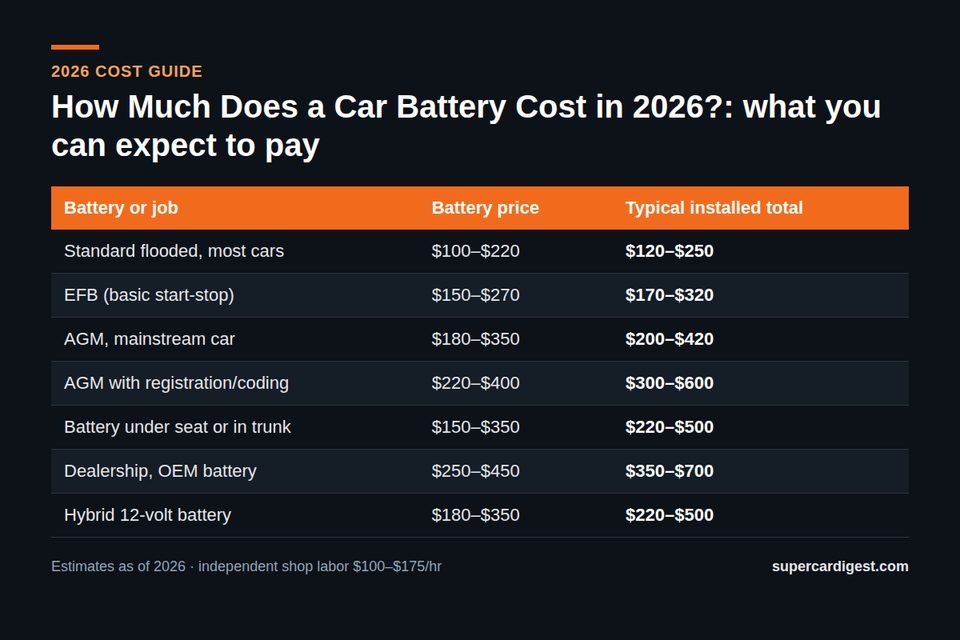
Car battery replacement cost in 2026 at a glance
| Battery or job | Battery price | Typical installed total |
|---|---|---|
| Standard flooded, most cars | $100–$220 | $120–$250 |
| EFB (basic start-stop) | $150–$270 | $170–$320 |
| AGM, mainstream car | $180–$350 | $200–$420 |
| AGM with registration/coding | $220–$400 | $300–$600 |
| Battery under seat or in trunk | $150–$350 | $220–$500 |
| Dealership, OEM battery | $250–$450 | $350–$700 |
| Hybrid 12-volt battery | $180–$350 | $220–$500 |
Most stores add a core charge of about $15–$30. You get it back when you bring in the old battery, and many stores take the old one for recycling automatically when they install the new one.
Flooded vs. AGM vs. EFB batteries
The biggest factor in price is the battery type your car was designed for. Using a cheaper type than the original can shorten battery life and cause electrical problems.
Standard flooded (lead-acid)
This is the traditional battery with liquid electrolyte. It is the cheapest option and fine for most older cars and many trucks without start-stop. Typical life is about three to five years, shorter in very hot climates.
EFB (enhanced flooded battery)
An EFB is a tougher flooded battery built to handle more charge cycles. Many entry-level cars with automatic start-stop use them. It sits between flooded and AGM in price.
AGM (absorbent glass mat)
AGM batteries hold the electrolyte in glass mats, resist vibration and handle frequent deep cycling. Most cars with start-stop, heavy electrical loads or a battery inside the cabin or trunk use AGM. If your car came with AGM, replace it with AGM. You can usually upgrade from flooded to AGM, but you cannot safely downgrade.
Check the label before you shop
Look at the top of your current battery for the group size (such as H6, 48 or 24F) and the letters AGM or EFB. Your owner’s manual also lists the correct type and cold cranking amps (CCA).
Battery registration and coding on newer cars
Many newer cars have an intelligent battery sensor and a charging system that adjusts to the age of the battery. On a lot of BMW, Mini, Audi, Volkswagen, Mercedes, Volvo and some Ford and GM models with start-stop, the new battery should be registered after installation so the car knows it has a fresh battery. If the battery capacity or type changes, the car may also need coding.
Skipping registration does not stop the car from starting, but the charging system may keep treating the new battery like an old one. That can overcharge it, shorten its life and trigger start-stop or electrical warnings.
- Dealers usually charge 0.3–1 hour of labor for registration, about $50–$200.
- Independent European specialists often charge less and use the same software.
- DIY registration is possible with a scan tool that supports it, typically $60–$200 for a basic tool with this function.
Signs you need a new battery
- Slow cranking, especially on cold mornings.
- Clicking when you turn the key, with dim dash lights.
- A battery warning light or start-stop system warning.
- Swelling, leaking or heavy corrosion around the terminals.
- Age of four years or more, especially in hot states.
Not every no-start is the battery. A clicking sound with bright lights can point to the starter, and a battery that keeps dying even after replacement may mean a bad alternator or a parasitic drain. See our guide to the symptoms of a bad starter for how to tell them apart.
Free testing and free installation
Many national auto parts stores offer free battery testing and will check your starter and alternator output in the parking lot. Many also offer free installation when you buy the battery from them, as long as the battery is under the hood and easy to reach. If the battery is under a seat, behind a wheel-well liner, or needs registration, they may decline and send you to a shop.
A proper test uses a conductance or load tester and gives a result such as “good,” “good, recharge” or “replace.” A battery that tests weak after a full charge is due for replacement. A battery that tests fine but keeps dying points to another problem.
Can you replace a car battery yourself?
On many cars, yes. With the battery under the hood, the job needs a 10 mm or 13 mm wrench, a terminal brush and about 20 minutes. Remove the negative cable, then the positive, then the hold-down clamp. Lift the old battery out carefully, since many weigh 30 to 50 pounds. Clean the terminals, install the new battery, tighten the hold-down, and connect positive first, then negative. A memory saver that plugs into the power outlet can keep radio and computer settings during the swap. Skip DIY if the battery is buried, if your car needs registration and you don’t have a compatible scan tool, or if you are not comfortable lifting it.
Battery warranty: what to look for
Most batteries come with a free replacement period, often two to four years, and some premium batteries add a prorated period after that. A longer free-replacement warranty usually costs more up front but can be worth it if you plan to keep the car. Keep your receipt, and note the purchase date. Many batteries also have a date code sticker on the case.
If your car is still under factory warranty, the original battery may be covered for the first few years. Some extended service plans also cover batteries. Our guide on whether extended car warranties are worth it explains what is typically included.
Safety first
Batteries contain acid and can release hydrogen gas. Wear eye protection, disconnect the negative terminal first and reconnect it last, and never let a wrench touch both terminals. On some cars, disconnecting the battery resets radio presets, window auto-up and idle settings.
How to pay less for a car battery
- Test before you buy. A free test can save you from replacing a good battery when the real issue is a loose clamp or corrosion.
- Buy the right type, not the most expensive. A store-brand battery with the right group size, type and CCA is often fine.
- Use free installation where it is offered.
- Return the core to get your deposit back.
- Use an independent specialist for registration on European cars instead of the dealer.
- Use a battery maintainer if the car sits for weeks at a time. Short trips and long storage shorten battery life.
A battery is a routine part, not a sign that a car is worn out. But if your older car keeps needing electrical work on top of other repairs, use our repair or replace calculator to see whether it still makes sense to keep it.
Useful on Amazon for this job
As an Amazon Associate we earn from qualifying purchases. Always confirm fit for your exact vehicle or ask your dentist.
Shop-floor tips for a battery swap
- Match the type, not just the size. If your car came with an AGM or EFB battery, especially with start-stop, replacing it with a regular flooded battery can shorten its life.
- Some cars need the new battery registered so the charging system adjusts, including many BMW and other European models and some newer domestic vehicles.
- Location can add labor. Batteries in the trunk, under a seat or behind a wheel liner take longer to reach.
- A memory saver helps keep radio presets and other settings on many cars while the battery is out.
- Clean the terminals. Corroded cable ends can cause starting and charging problems even with a new battery.
- Remove negative first, install negative last, and double-check polarity. Reversed cables can blow fuses and damage electronics.
- A dead new battery may not be the battery. A parasitic drain or weak alternator can kill it; ask for a charging system test.
Super Car Digest · $14
The Used Car Buying Playbook
Big repair bill on an older car? Before you pay for it, run the numbers on replacing the car — and if you do switch, don’t overpay for the next one. Budget worksheet, 15-minute VIN screen, test-drive routine, word-for-word negotiation scripts and a 10-point contract check.
Frequently asked questions
How much does it cost for a car battery?
About $120–$250 installed for a standard battery and $200–$450 for an AGM battery. Cars that need registration can cost $300–$700. Estimates as of 2026.
How long does a car battery last?
Usually three to five years. Heat, short trips, long periods of sitting and heavy electrical use can shorten that.
Can I put a regular battery in a car that came with AGM?
It is not recommended. The charging system and start-stop function are designed for AGM, and a flooded battery may fail early.
Do auto parts stores install batteries for free?
Many do, when you buy the battery there and it is easy to reach. Batteries in the trunk, under seats or that need coding may be excluded.
Do I need to register a new battery?
Many European and start-stop vehicles require it. Check your owner’s manual or ask a shop that works on your brand.
How long does it take to replace a car battery?
About 15–30 minutes for most cars, and up to an hour or more when the battery is hard to reach or needs registration.
Sources and methodology
Price ranges combine 2026 retail prices from national auto parts chains for flooded, EFB and AGM batteries, published labor times for battery replacement and registration, and labor at typical 2026 shop rates ($100–$175/hr independent, $150–$250/hr dealer; AAA has reported national averages around $140/hr). These are estimates; your price will vary by vehicle, battery brand, warranty and region.