Key takeaways
- A single O2 sensor replacement typically costs $150–$400 at an independent shop. The sensor costs $40–$250; labor is usually 0.5–1 hour.
- Upstream sensors (before the catalytic converter) and air-fuel ratio sensors cost more than downstream sensors (after the converter).
- Codes P0130–P0167 point to an O2 sensor circuit. P0420 usually points to the catalytic converter, not the sensor.
- Dealers often charge $250–$550+ per sensor with an OEM part; hard-to-reach sensors on V6 and V8 engines cost more.
- Estimates as of 2026; your price depends on the vehicle, sensor brand and local labor rates ($100–$175/hr independent, $150–$250/hr dealer).
The O2 sensor replacement cost for most cars in 2026 is about $150 to $400 per sensor at an independent shop: roughly $40–$250 for the sensor and $50–$175 in labor. Dealers using OEM parts commonly land between $250 and $550. If you searched for 02 sensor replacement cost, it is the same part; the “O” stands for oxygen. This guide covers upstream vs. downstream sensor prices, what the common trouble codes mean, why P0420 confuses so many owners, how a bad sensor affects gas mileage, and how to avoid paying for a part you do not need.
📩 Important: after you sign up, open the email from Super Car Digest and tap Confirm. Your checklist opens right away. Not there? Check Spam or Promotions.
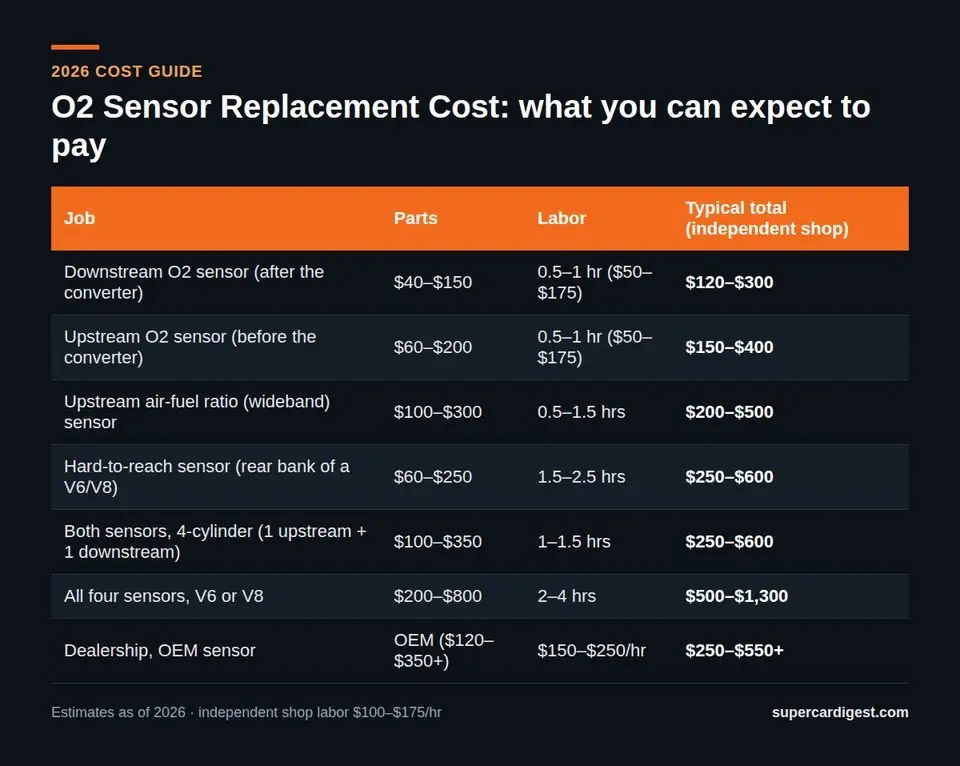
O2 sensor replacement cost in 2026 at a glance
| Job | Parts | Labor | Typical total (independent shop) |
|---|---|---|---|
| Downstream O2 sensor (after the converter) | $40–$150 | 0.5–1 hr ($50–$175) | $120–$300 |
| Upstream O2 sensor (before the converter) | $60–$200 | 0.5–1 hr ($50–$175) | $150–$400 |
| Upstream air-fuel ratio (wideband) sensor | $100–$300 | 0.5–1.5 hrs | $200–$500 |
| Hard-to-reach sensor (rear bank of a V6/V8) | $60–$250 | 1.5–2.5 hrs | $250–$600 |
| Both sensors, 4-cylinder (1 upstream + 1 downstream) | $100–$350 | 1–1.5 hrs | $250–$600 |
| All four sensors, V6 or V8 | $200–$800 | 2–4 hrs | $500–$1,300 |
| Dealership, OEM sensor | OEM ($120–$350+) | $150–$250/hr | $250–$550+ |
Many shops also charge a diagnostic fee of $50–$150 to confirm which sensor failed. Some waive it if you have the repair done there.
What an O2 sensor does: upstream vs. downstream
An oxygen (O2) sensor screws into the exhaust and measures how much oxygen is left after combustion. The engine computer uses that reading to add or remove fuel many times per second, keeping the air-fuel mix close to ideal.
Most four-cylinder cars have two sensors. V6 and V8 engines usually have four, one before and one after each catalytic converter. Shops name them by position:
- Upstream (Sensor 1) sits before the catalytic converter. It controls fueling, so a bad one hurts gas mileage and drivability. Many newer cars use a wideband air-fuel ratio sensor here, which costs more.
- Downstream (Sensor 2) sits after the converter. It mainly checks whether the converter is working. A bad downstream sensor rarely affects how the car runs, but it will turn on the check engine light.
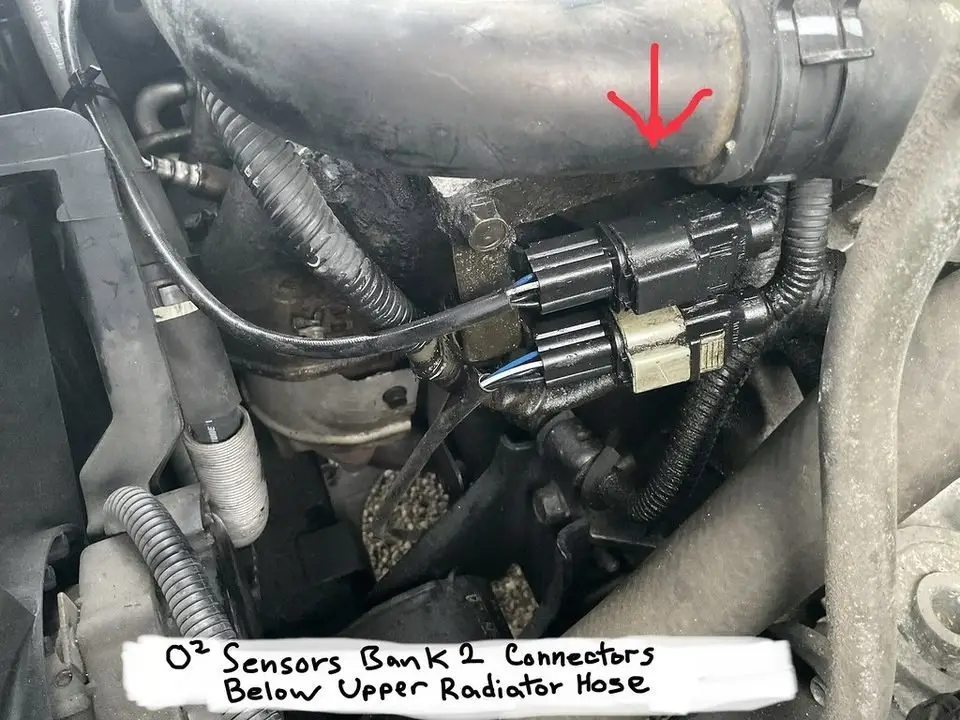
- Bank 1 is the side of the engine with cylinder 1. Bank 2 is the other side on a V6 or V8. Four-cylinder engines only have Bank 1.
O2 sensor codes and the P0420 confusion
The codes from P0130 to P0167 are the standard O2 sensor circuit codes. They tell you which sensor and what kind of fault the computer saw, such as a slow response, a low or high voltage, or no activity.
| Code range | Sensor location |
|---|---|
| P0130–P0135 | Bank 1, Sensor 1 (upstream) |
| P0136–P0141 | Bank 1, Sensor 2 (downstream) |
| P0142–P0147 | Bank 1, Sensor 3 (some vehicles) |
| P0150–P0155 | Bank 2, Sensor 1 (upstream) |
| P0156–P0161 | Bank 2, Sensor 2 (downstream) |
| P0162–P0167 | Bank 2, Sensor 3 (some vehicles) |
P0420 (and P0430 for Bank 2) means “catalyst efficiency below threshold.” The downstream sensor reports the problem, so many owners replace that sensor first. Most of the time the sensor is fine and the catalytic converter is worn out, or an exhaust leak, misfire or oil burning is damaging it. A good shop will look at live sensor data before replacing anything. Replacing a $100 sensor is a reasonable first step only if the sensor itself has also set a circuit code or reads poorly on a scan tool.
Fix misfires first
A misfire dumps unburned fuel into the exhaust and can trigger O2 and catalyst codes. If you also have a misfire code, deal with it first. Worn spark plugs or a failing ignition coil are common causes and cost far less than a converter.
Signs of a bad O2 sensor
- Check engine light with a code in the P0130–P0167 range or a heater circuit code.
- Worse gas mileage, often noticed as fewer miles per tank.
- Rough idle, hesitation or stalling, usually from a failing upstream sensor.
- Failed emissions test or a car that will not show “ready” for inspection.
- Rotten-egg smell or black smoke, which can mean the engine is running rich.
O2 sensors wear slowly. Many last 60,000–100,000 miles, and older unheated designs fail sooner. Oil burning and coolant leaks can contaminate a sensor early.
Does a bad O2 sensor hurt gas mileage?
It can. A slow or biased upstream sensor may tell the computer the engine is lean, so it adds more fuel than needed. The federal fueleconomy.gov site notes that fixing a serious maintenance problem such as a faulty oxygen sensor can improve mileage by as much as 40%. Most cars lose far less, but a drop of a few miles per gallon is common. A bad downstream sensor usually has little effect on mileage.
Is it safe to drive with a bad O2 sensor?
In the short term, usually yes. A bad O2 sensor does not affect brakes or steering, and many cars run normally with a failed downstream sensor. The cost of waiting is mostly fuel and emissions.
A failing upstream sensor is a bigger deal over time. If the engine runs rich for months, extra fuel can overheat and damage the catalytic converter, which often costs $1,000–$2,500 or more to replace. A lit check engine light also hides any new problem that appears later.
Get it checked soon if you notice these
A flashing check engine light, heavy black smoke, a strong fuel or sulfur smell, or a car that stalls or hesitates in traffic. These point to a misfire or rich condition that can damage the converter quickly.
What drives the price up or down
1. Sensor type and position
Downstream sensors are the cheapest. Upstream narrowband sensors cost a bit more, and wideband air-fuel ratio sensors can cost $100–$300 on their own. Always match the exact part for your engine and position.
2. Access
Many sensors take 20–40 minutes. On some transverse V6 engines, the rear-bank upstream sensor sits against the firewall and may require removing the intake plenum or working from underneath, which can push labor to 2 hours or more.
3. Rust and seized threads
In snowy states, sensors can rust into the exhaust. Shops may need heat and extra time. In bad cases the threads in the pipe or manifold need repair, which adds $50–$200.
4. OEM vs. aftermarket
Quality sensors from the original supplier brands often cost less at parts stores than the same part in a dealer box. Very cheap “universal” sensors that need wire splicing can cause repeat codes and are best avoided.
Dealer vs. independent shop vs. DIY
| Option | Typical cost per sensor | Pros | Cons |
|---|---|---|---|
| Dealership | $250–$550+ | OEM sensor, factory scan tools | Highest labor rate and parts markup |
| Independent shop | $150–$400 | Fair labor rate, choice of brands | Diagnostic skill varies by shop |
| Chain shop | $150–$400 | Quick, often coupons | May replace sensors without testing |
| DIY | $40–$250 in parts | Lowest cost | Needs an O2 sensor socket, penetrating oil and an OBD-II scanner |
DIY is one of the easier jobs when the sensor is easy to reach. Work on a warm (not hot) exhaust, use a slotted O2 sensor socket, and clear the codes afterward.
How to pay less without cutting corners
- Confirm the diagnosis. Ask the shop to show you live sensor data, especially before replacing a downstream sensor for a P0420.
- Replace only the failed sensor. Sensors do not need to be changed in pairs unless both have codes or high mileage.
- Buy a quality direct-fit part. An original-supplier brand from a parts store is often the best value.
- Get two quotes, one from an independent shop. This job rarely needs a dealer.
- Check your coverage. Some sensors are covered under emissions or extended warranties. See are extended car warranties worth it?
When to walk away from the repair
An O2 sensor is almost never a reason to give up on a car. Even four sensors on a V8 cost less than many single repairs. The math changes when the sensor codes come with a failed catalytic converter, heavy oil burning or a long list of other problems, such as an oil leak and worn suspension. Add up every repair and compare the total with the car’s value. Our guide on whether it’s worth fixing an old car explains the 50% rule, and our repair or replace calculator runs the numbers for you.
Super Car Digest · $14
The Used Car Buying Playbook
Big repair bill on an older car? Before you pay for it, run the numbers on replacing the car — and if you do switch, don’t overpay for the next one. Budget worksheet, 15-minute VIN screen, test-drive routine, word-for-word negotiation scripts and a 10-point contract check.
Frequently asked questions
How much does it cost to replace an O2 sensor?
About $150–$400 per sensor at an independent shop and $250–$550 or more at a dealer. Hard-to-reach sensors on V6 and V8 engines can cost up to about $600. Estimates as of 2026.
Is an upstream or downstream O2 sensor more expensive?
The upstream sensor usually costs more, especially if it is a wideband air-fuel ratio sensor. Downstream sensors are typically the cheapest to replace.
Will a new O2 sensor fix code P0420?
Usually not. P0420 most often means the catalytic converter is no longer working well. Replace the sensor only if testing shows it is slow or faulty, or if it has its own circuit code.
Can I drive with a bad O2 sensor?
For a short time, usually yes. Expect worse gas mileage and possible emissions test failure. A long-term rich condition can damage the catalytic converter, so plan the repair within a few weeks.
How long do O2 sensors last?
Many modern heated sensors last 60,000–100,000 miles or more. Oil burning, coolant leaks and misfires can shorten their life.
Should I replace all O2 sensors at once?
Not necessarily. Replace the sensor that failed. On a high-mileage car, doing both upstream sensors together can make sense.
Sources and methodology
Price ranges combine 2026 estimates from the RepairPal estimator for oxygen sensor replacement, published labor-time guides, current retail pricing for aftermarket and OEM sensors, generic OBD-II code definitions, fuel economy guidance from fueleconomy.gov, and labor at typical 2026 shop rates ($100–$175/hr independent, $150–$250/hr dealer; AAA has reported national averages around $140/hr). These are estimates; your quote will vary by vehicle, region and condition.