Key takeaways
- Replacing one lower control arm typically costs $250–$700 at an independent shop, including the alignment.
- An upper control arm is often $200–$550; replacing a pair of arms on one axle runs about $450–$1,200.
- Bushings only cost less in parts but more in labor: about $150–$450 per arm. On many cars, a complete arm is the better deal.
- Most new arms come with the ball joint and bushings already installed, which is why whole-arm replacement has become the default.
- Estimates as of 2026; costs depend on the vehicle, part quality and local labor rates ($100–$175/hr independent, $150–$250/hr dealer).
The control arm replacement cost in 2026 is roughly $250 to $700 per arm at an independent shop, with parts usually $60–$300 and labor $100–$350, plus an alignment. Dealers often charge $500–$1,200 per arm with OEM parts, and some luxury cars with aluminum multi-link suspensions run higher still. Control arms hold your wheels in place, so worn bushings or a loose ball joint show up as clunks, wandering and uneven tire wear. Here is what you will pay, what the shop is replacing, and when replacing just the bushings makes sense.
📩 Important: after you sign up, open the email from Super Car Digest and tap Confirm. Your checklist opens right away. Not there? Check Spam or Promotions.
Control arm replacement cost in 2026 at a glance
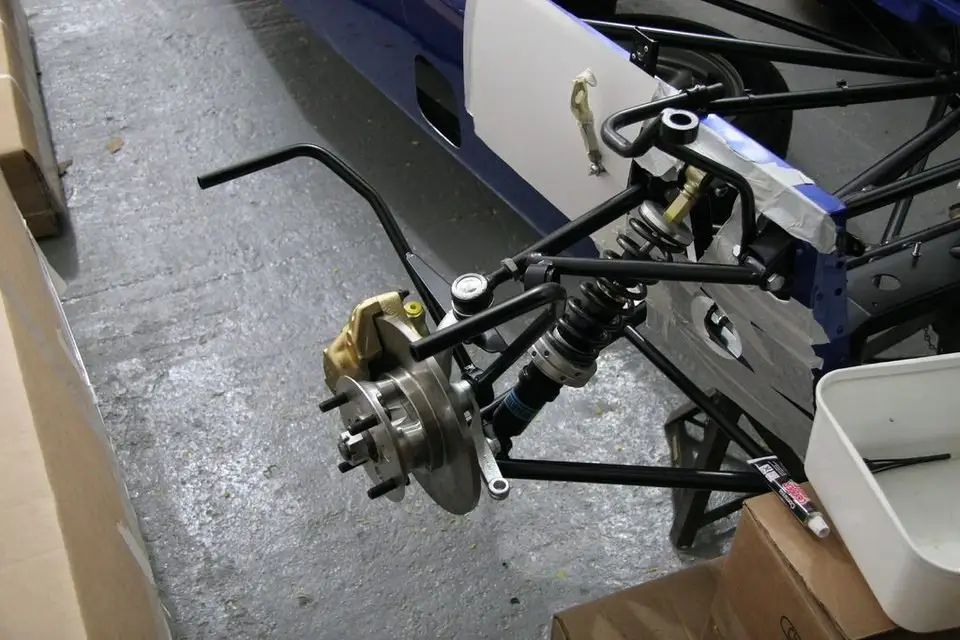
| Job | Parts | Labor | Typical total (independent shop) |
|---|---|---|---|
| Lower control arm, one side (with ball joint) | $60–$300 | 1–2 hrs ($100–$350) | $250–$700 |
| Upper control arm, one side | $50–$250 | 1–1.5 hrs | $200–$550 |
| Pair of lower arms, same axle | $120–$600 | 2–3.5 hrs | $450–$1,200 |
| Control arm bushings only, per arm | $15–$80 | 1.5–3 hrs | $150–$450 |
| Ball joint only (press-in), per side | $20–$100 | 1–2.5 hrs | $150–$400 |
| Wheel alignment | — | 0.5–1 hr | $100–$200 |
| Luxury multi-link front arm (aluminum) | $150–$600+ | 1.5–3 hrs | $500–$1,300+ |
| Dealership, one arm with OEM parts | OEM | $150–$250/hr | $500–$1,200 |
What a control arm does: upper vs. lower
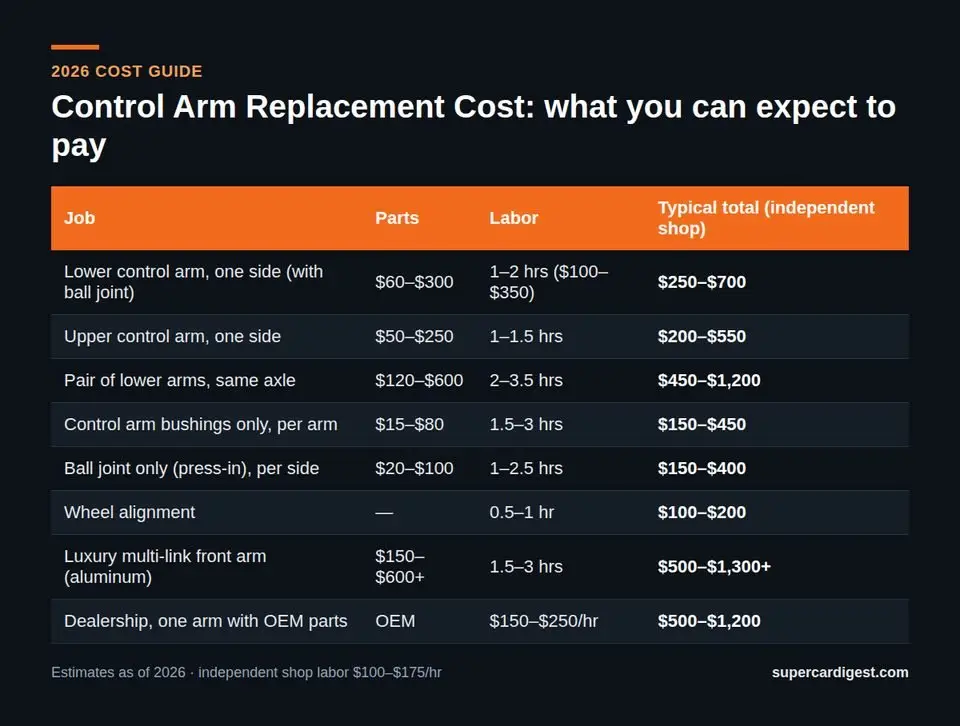
A control arm is a hinged link between the car’s frame or subframe and the steering knuckle that holds the wheel. It lets the wheel move up and down over bumps while keeping it in the right position. Each arm has three key parts:
- The arm itself — stamped steel, cast iron or aluminum.
- Bushings — rubber or polyurethane sleeves where the arm mounts to the frame. They absorb vibration and allow the arm to pivot.
- Ball joint — the pivot at the wheel end, which lets the knuckle steer and move with the suspension.
Most front-wheel-drive cars with MacPherson struts have only a lower control arm on each front corner. Pickups, many SUVs and performance cars with double-wishbone suspensions have both upper and lower arms. Multi-link rear suspensions can have several smaller arms per wheel, each sold separately.
Lower arms carry more load and usually wear first. Upper arms are smaller, cheaper and often quicker to swap.
Signs of a bad control arm
- Clunking or knocking over bumps, potholes or driveway entrances.
- Steering wander — the car drifts and needs constant correction.
- Shimmy or vibration in the steering wheel, often at a certain speed.
- Clunk when braking or accelerating, as worn bushings let the wheel shift forward and back.
- Uneven tire wear on the inner or outer edge.
- Cracked, split or bulging bushings visible during an inspection.
- Play in the ball joint when the wheel is rocked top to bottom.
Many of these overlap with tie rod, strut and sway-bar link problems. A shop with a lift and a pry bar can usually pinpoint the worn part in a few minutes, so get a diagnosis before ordering anything.
Is it safe to drive with a bad control arm?
It depends on what is worn. Slightly cracked bushings cause noise and mild tire wear, and many cars drive for months that way. That is not ideal, but it is not an emergency. Get it fixed within a few weeks.
A loose ball joint is different. If it separates, the wheel can fold under the car, usually while turning or hitting a bump. If the shop measures excessive ball joint play, or you hear heavy clunks and feel the steering shift, limit driving to a short, slow trip to the shop or have it towed. A cracked or bent arm after a pothole or curb strike falls in the same category.
After a hard pothole or curb hit
If the steering wheel is suddenly off-center or the car pulls hard, a control arm or tie rod may be bent. Don’t just get an alignment — a bent arm can’t be aligned correctly. Ask the shop to inspect the arms before adjusting anything.
Bushings only or the whole arm?
Years ago, shops pressed new bushings and ball joints into the original arm. Today, complete arms with new bushings and a ball joint are widely available for $60–$200 on common cars. Pressing out old bushings can take two or three hours, so the labor often costs more than the new arm.
Bushings-only still makes sense when:
- The arm is expensive (some trucks, luxury cars and aluminum arms).
- The ball joint is separate and still tight.
- You want polyurethane or performance bushings on an enthusiast car.
For a typical sedan or crossover, a quality complete arm is usually faster, cheaper overall and gives you new parts everywhere that wears.
What drives the price up or down
1. Vehicle and suspension design
A lower arm on a common compact car might be four bolts and a pinch bolt. On some trucks and luxury cars, the subframe, sway bar or axle has to be loosened, and labor climbs to three hours or more.
2. Rust and seized bolts
Control arm bolts pass through rubber-bonded steel sleeves that can rust solid. Cutting a seized bolt adds labor and a new bolt kit. Expect higher quotes in the Rust Belt.
3. Alignment
Replacing a lower arm on many cars changes camber and caster slightly, so an alignment ($100–$200) is usually recommended. Some arms bolt in fixed positions; ask the shop whether yours needs it, and get it if there is any doubt.
4. Part brand
The cheapest online control arms can have weak ball joints and soft bushings. Mid-grade aftermarket or OEM arms cost more upfront but rarely need redoing.
Dealer vs. independent shop vs. DIY
| Option | One lower arm | Pair of lower arms | Notes |
|---|---|---|---|
| Dealership | $500–$1,200 | $900–$2,000 | OEM parts, highest labor rate |
| Independent shop | $250–$700 | $450–$1,200 | Quality aftermarket or OEM, includes alignment |
| DIY + shop alignment | $160–$500 | $220–$800 | Jack stands, breaker bar, torque wrench |
Bolting in a complete control arm is a reasonable job for a careful DIYer on many front-wheel-drive cars. The key details: torque the bushing bolts with the car at ride height (on ramps or with the suspension jacked up), not with the wheel hanging, or the new bushings will twist and wear early. Pressing bushings or ball joints is a job better left to a shop with a press.
Super Car Digest · $14
The Used Car Buying Playbook
Big repair bill on an older car? Before you pay for it, run the numbers on replacing the car — and if you do switch, don’t overpay for the next one. Budget worksheet, 15-minute VIN screen, test-drive routine, word-for-word negotiation scripts and a 10-point contract check.
How to pay less without cutting corners
- Ask to see the worn part on the lift. Bushings and ball joints are easy to show.
- Price a complete arm against bushings-only labor.
- Bundle front-end work — control arms, tie rods and sway-bar links share one alignment.
- Get an independent quote. This is routine suspension work.
- Check your warranty. Some extended plans cover suspension parts; see the average monthly cost of an extended car warranty to judge whether coverage pays off.
When to walk away instead
One or two control arms are a normal repair on a car with 100,000 miles. But worn arms often come with worn struts, tie rods and CV axles, and the total can reach $2,000–$3,000. If that bill is more than about half the car’s value, or other big repairs are waiting, read is it worth fixing an old car? before approving the work. If you’re shopping instead, our guide on how many miles is too many for a used car explains when to expect this kind of wear.
Frequently asked questions
How much does it cost to replace a control arm?
About $250–$700 per lower arm and $200–$550 per upper arm at an independent shop, including an alignment. Dealers often charge $500–$1,200 per arm. Estimates as of 2026.
Should control arms be replaced in pairs?
It isn’t required, but on a high-mileage car the other side is usually worn too. Replacing both keeps handling even and shares one alignment.
Do you need an alignment after replacing a control arm?
Usually, yes. New bushings and ball joints can shift camber and caster slightly. An alignment protects your tires.
How long does it take to replace a control arm?
Typically 1–2 hours per arm, plus 30–60 minutes for the alignment. Rusty bolts or subframe access can add time.
How long do control arms last?
Many last 90,000–150,000 miles. Bushings crack with age and heat, and potholes, rough roads and oil leaks onto rubber shorten their life.
Is it cheaper to replace bushings or the whole control arm?
On most common cars, the whole arm is cheaper overall because pressing bushings takes so much labor. Bushings-only can win on expensive aluminum or truck arms.
Sources and methodology
Price ranges combine 2026 estimates from the RepairPal estimator for control arms, bushings, ball joints and alignments, published labor-time guides, current retail parts pricing and labor at typical 2026 shop rates ($100–$175/hr independent, $150–$250/hr dealer; AAA has reported national averages around $140/hr). These are estimates; your quote will vary by vehicle, region and condition.