
Key takeaways
- Ask the first eight questions by text or email before you drive anywhere — half of bad cars disqualify themselves at this stage.
- The three answers that end the conversation: no title in hand, “the check-engine light just needs a sensor”, and “no, you can’t take it to a mechanic”.
- At a dealer, the only number that matters is the out-the-door price in writing; everything else is a distraction.
- Pair these questions with our 60-point inspection checklist when you see the car in person.
Most of what you need to know about a used car can be learned before you see it, if you ask the right questions in the right order. Sellers rarely lie outright, but they leave things out, and the questions below are designed so that an evasive answer is as informative as an honest one. We’ve split them into what to ask before the visit, what to ask in person, and what to ask a dealer specifically.

Before you go: 8 questions to ask by message
- “Why are you selling it?” Normal answers: new car, moving, family changes, no longer need two cars. Vague or shifting answers are a flag.
- “Do you have the title in hand, in your name?” If the title is with a lender, ask how the payoff will work. If it’s in someone else’s name (“selling for my cousin”), that’s title-jumping — walk away.
- “Can you send me the VIN?” A seller who won’t share the VIN has a reason. Run a history report and check recalls at nhtsa.gov/recalls before the visit.
- “How many owners, and how long have you had it?” One or two owners over its life is ideal; a car that has changed hands three times in two years is being passed along for a reason.
- “Any accidents, bodywork or paint?” Compare the answer to the history report. Minor cosmetic repairs are fine; “no” when the report shows a reported collision is not.
- “Are there any warning lights on, or anything that doesn’t work?” “The check-engine light is just an O2 sensor” is the most common sentence in used-car ads. Treat an unexplained light as an unknown repair of $200–$2,000.
- “Do you have service records?” Oil changes plus any timing belt, transmission or brake work. Records matter more than mileage — see how many miles is too many.
- “Are you OK with me taking it to a mechanic for a pre-purchase inspection?” Any hesitation ends the conversation. A $100–$200 PPI is the best protection you can buy.
In person: 12 questions to ask while you inspect
- “When was the oil last changed, and with what?” Then check the dipstick yourself: level, color, and no milky residue.
- “When were the tires and brakes replaced?” Tires are $500–$1,100 a set; brakes $400–$900 an axle. If they’re due, that’s a negotiation item.
- “Has the timing belt been done?” (If the engine has one — many 4-cylinders and V6s do.) Due at 60k–100k miles, $600–$1,200. No proof means assume it hasn’t.
- “Has the transmission fluid ever been changed?” Especially on CVTs and anything over 80,000 miles.
- “Where has the car lived?” Rust Belt and coastal cars need an underbody check; Southern cars suffer sun-baked plastics and dashboards.
- “Has it ever been in a flood or had water inside?” Then lift the carpet in the trunk and under the mats and smell for mildew.
- “Does the AC blow cold?” Test it yourself for five minutes. AC repairs run $150 to $2,500.
- “Do you have both keys?” A second smart key or fob costs $200–$500 to replace.
- “Was it ever used for rideshare, delivery or as a rental?” Not disqualifying, but it should be priced as high-use.
- “Is anything modified or not stock?” Aftermarket tunes, lifts and exhausts can void warranties and hide problems.
- “Is there anything you’d fix if you were keeping it?” Honest sellers will tell you about the small stuff. Silence tells you something too.
- “What’s your bottom line if I can pick it up this week?” Ask only after you’ve inspected and driven it. See how to negotiate a used car price.
At a dealer: 5 extra questions
- “What is the out-the-door price, in writing?” Includes tax, title, doc fee and every add-on. Negotiate this number only, never the monthly payment.
- “What is your doc fee, and what dealer add-ons are already on the car?” Doc fees range from $0 to $900+ depending on the state; pre-installed “protection packages”, nitrogen and etching are negotiable or removable.
- “Is this certified pre-owned, and can I see the inspection report?” CPO adds a real warranty; ask what it covers and for how long.
- “Is the price the same if I pay cash or use my own financing?” Some dealers price assuming they earn on the loan. Get pre-approved at a credit union first so you can say yes to your own financing.
- “Can I take it for an independent inspection?” Reputable dealers allow it. Those that don’t have told you what you need to know.
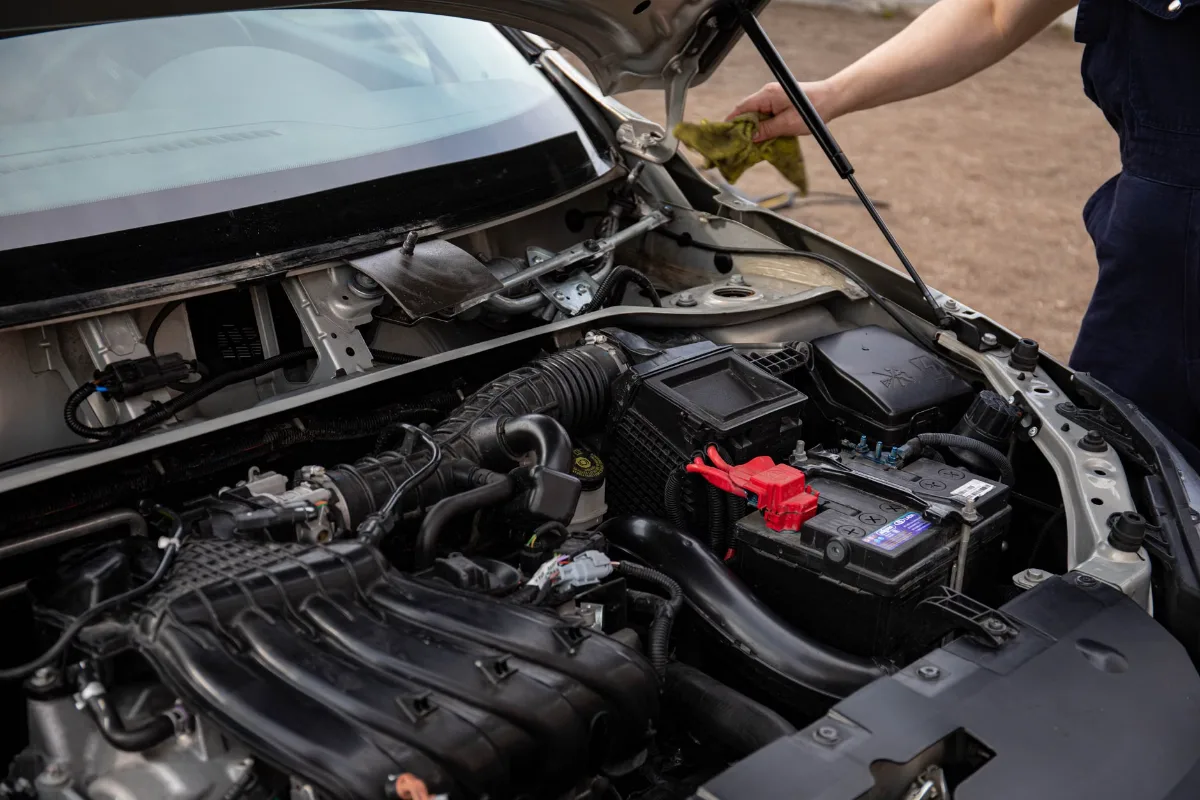
Answers that should end the deal
- No title in hand, or title not in the seller’s name.
- Refusal to allow a pre-purchase inspection.
- A salvage, rebuilt, flood or lemon-law title brand (unless priced accordingly and you know exactly what you’re buying).
- Mileage on the odometer that doesn’t match service records or the history report.
- “Cash only, today, I have another buyer coming.”
- A dealer who will only discuss the monthly payment.
What to do with the answers
Every honest “no” — no recent tires, no timing belt, no records of the transmission service — is a line item with a dollar value, and together they become your offer. Write them down with rough costs (our repair cost guides have current ranges), present the list calmly, and make an offer that reflects it. Then, before you say yes, run the car through the True Cost of Ownership calculator so the monthly reality, not the asking price, makes the final decision.
60 inspection points, deal-breakers, negotiation scripts and a cost worksheet — printable or on your phone.